
ARCHIVE
Researchers used sophisticated neuroimaging and powerful predictive analytics to reveal decreased blood flow in specific brain regions and correlate these findings with cognitive and behavioral impairment, according to a new report in the Journal of Alzheimer’s Disease. Amsterdam, NL, April 26, 2016 – The discovery of brain pathology through autopsy in former National Football League (NFL) players called chronic traumatic encephalopathy (CTE) has raised substantial concern among players, medical professionals, and the general public about the impact of repetitive head trauma. Using sophisticated neuroimaging and analytics, researchers have now identified abnormal areas of low blood flow in living professional football players. These findings, published in the Journal of Alzheimer’s Disease, raises the potential for better diagnosis and treatment for persons with football-related head trauma. “This report opens the study of traumatic brain injury to well-established brain imaging approaches,” commented George Perry, Ph.D., Editor in Chief of the Journal of Alzheimer’s Disease. “The findings suggest that brain hypoperfusion may play a role in the development of the clinical changes seen in NFL players.”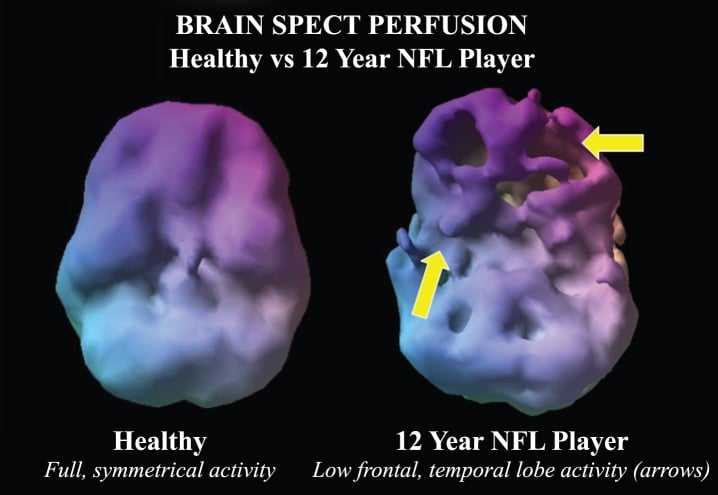 This study used cerebral perfusion imaging with single-photon emission computed emission tomography (SPECT) to examine the brains of the largest group of retired and current NFL players investigated to date, a total of 161 individuals with an average age of 52. Looking at blood flow to every region of the brain, researchers were able to identify areas of abnormally low blood flow. Combining this information with a leading-edge quantitative approach called machine learning allowed them to distinguish NFL players with abnormal brain patterns compared to healthy controls with 92-94% accuracy.
“Without functional imaging studies like SPECT, it is very difficult to know if brain trauma is present and which areas are affected,” explained lead author Daniel G. Amen, MD, Amen Clinics, Inc, Costa Mesa, CA. “Structural studies often appear normal but what we can do better with functional neuroimaging with SPECT is not only pinpoint specific areas of the brain that are unhealthy with low blood flow but also demonstrate their improvement with successful brain rehabilitation treatments in persons like football players.”
Co-author Dr. Bennet Omalu who originally described CTE as depicted in the movie Concussion, featuring Will Smith added, “What our current work is doing in addition to other imaging modalities builds the foundation between identifying the negative effects of head trauma on the brain while the patient is still alive so that we can intervene with better treatments.”
Investigators determined that on average the NFL players had lower blood flow in 36 areas of the brain. The decreased blood flow in the following six regions of the brain was the most important in determining who had football related health trauma: anterior superior temporal lobes, rolandic operculum, insula, superior temporal poles, precuneus and, cerebellar vermis. These same regions function in memory, mood, and learning. When damaged, they can produce cognitive and psychiatric problems as evidenced by the fact that 83% of players in this study had memory problems and 29% of them had a history of depression.
According to lead investigator Cyrus A. Raji, MD, Ph.D., University of California Los Angeles Medical Center, “This convergence of a critical research question of high national interest, functional neuroimaging, and new computer-based predictive analytics makes this study both intriguing and impactful. It is of key importance not only for the neurological safety of football players but for the general public as well.”
This study used cerebral perfusion imaging with single-photon emission computed emission tomography (SPECT) to examine the brains of the largest group of retired and current NFL players investigated to date, a total of 161 individuals with an average age of 52. Looking at blood flow to every region of the brain, researchers were able to identify areas of abnormally low blood flow. Combining this information with a leading-edge quantitative approach called machine learning allowed them to distinguish NFL players with abnormal brain patterns compared to healthy controls with 92-94% accuracy.
“Without functional imaging studies like SPECT, it is very difficult to know if brain trauma is present and which areas are affected,” explained lead author Daniel G. Amen, MD, Amen Clinics, Inc, Costa Mesa, CA. “Structural studies often appear normal but what we can do better with functional neuroimaging with SPECT is not only pinpoint specific areas of the brain that are unhealthy with low blood flow but also demonstrate their improvement with successful brain rehabilitation treatments in persons like football players.”
Co-author Dr. Bennet Omalu who originally described CTE as depicted in the movie Concussion, featuring Will Smith added, “What our current work is doing in addition to other imaging modalities builds the foundation between identifying the negative effects of head trauma on the brain while the patient is still alive so that we can intervene with better treatments.”
Investigators determined that on average the NFL players had lower blood flow in 36 areas of the brain. The decreased blood flow in the following six regions of the brain was the most important in determining who had football related health trauma: anterior superior temporal lobes, rolandic operculum, insula, superior temporal poles, precuneus and, cerebellar vermis. These same regions function in memory, mood, and learning. When damaged, they can produce cognitive and psychiatric problems as evidenced by the fact that 83% of players in this study had memory problems and 29% of them had a history of depression.
According to lead investigator Cyrus A. Raji, MD, Ph.D., University of California Los Angeles Medical Center, “This convergence of a critical research question of high national interest, functional neuroimaging, and new computer-based predictive analytics makes this study both intriguing and impactful. It is of key importance not only for the neurological safety of football players but for the general public as well.”
Take a Look
How can you really know if you have a head injury unless you get an image of your brain? Brain SPECT imaging is the best tool for determining if your brain has suffered functional damage from a concussion or TBI—CT and MRI studies aren’t sensitive enough to do this. Our Full Evaluation includes two SPECT images (concentrating and resting states), a detailed clinical history, neuropsychological testing and comprehensive evaluation with one of our doctors to target treatment specifically to your brain, using the least toxic, most effective means. If you’ve had a concussion or TBI and are experiencing anxiety, depression, aggressive behaviors, or memory loss, call us today at 888-288-9834 or visit us online to schedule a visit At Amen Clinics, we knew about the NFL concussion problem 25 years ago, simply because we were looking at brains. We quickly learned these tragic facts: even mild traumatic brain injury (TBI) can ruin someone’s life, and the underlying impact of TBI on mental health problems is missed because most doctors don’t look at the brain.Undiagnosed concussions and TBIs are a very serious problem.
They are a major cause of psychiatric disorders including anxiety, depression, substance abuse, and panic disorder along with homelessness, domestic violence, divorce, and suicide. Furthermore, untreated brain injuries can lead to Alzheimer’s disease and other dementias. Although we have heard about the NFL concussion crisis in the media over the past several years, this issue was brought into the spotlight when the movie, Concussion, starring Will Smith, was released. The story features the work of Dr. Bennet Omalu, who more than a decade ago, identified the physical brain pathology of Chronic Traumatic Encephalopathy (CTE). Dr. Daniel Amen was a consultant on this very important film and highly recommends seeing it because it will really help you understand the devastating, long-term impact that head trauma has on the individuals who suffer from its consequences.How Do You Know Unless You Look?
Because we look at the brain using brain SPECT imaging, many people with a history of TBI come to Amen Clinics for evaluation, including professional athletes. In fact, Dr. Amen is the lead researcher on the first and largest brain imaging and rehabilitation study on NFL players. This research not only demonstrated high levels of brain damage in players, but also showed the possibility of significant recovery for many of them using the principles that underlie our work, including nutrition, supplementation, and exercise. We apply these same principles for brain health to all patients with TBI. As inferred above, one of the most prevalent conditions we identify with SPECT is previously undiagnosed TBI. All too often concussions are not taken very seriously unless a person has noticeable symptoms shortly after one occurs. Many times, clinicians do not know to ask their patients about a past history of head injuries. However, we think it is very important to ask them multiple times in multiple ways because people often forget or dismiss such incidents as inconsequential, but they all matter – even sub-concussive events. If you don’t already have your own set of questions for assessing a history of head injury, consider using ones like these:- Have you ever been knocked unconscious? If so, for how long?
- Have you ever temporarily “blacked out?”
- Have you ever gotten your “bell rung?”
- Have you ever fallen down or been hit and felt disoriented, confused or nauseous afterward?
- Did you play sports such as football, rugby, soccer, lacrosse or ice hockey?
- Have you ever crashed while skiing, snowboarding, skateboarding, cycling, or skating?
- When you were a child, did you ever fall out of a tree, off the jungle gym, off a porch, or out of a window?
- Have you ever been in a car accident, even a minor one and even if you didn’t hit your head? If so, how many?
Avoid High-risk Sports
If a child or teen really wants to play a sport that’s known to be dangerous, should their parents just go along with it? To spin it a different way, if a child wanted to do cocaine, would a parent help them find a drug dealer? Of course not! Unfortunately, too many parents allow their kids to engage in sports that put their brains at risk: tackle football, ice hockey, rugby, boxing, cheerleading, and bouncing soccer balls off their heads – to name a few. These sports all have a high risk of concussion. Since the resulting impairment from a concussion often resembles what drugs do to the brain, how can parents allow their kids to play high-risk sports that can give them brain damage and negatively impact the rest of their lives? Regardless of what coaches, doctors or other “experts” say, the best advice is to keep your kid out of the game. The risk is far too great when it comes to punishing contact sports.Take It from the Concussion Expert
The work of Dr. Bennet Omalu, who identified the physical brain pathology of Chronic Traumatic Encephalopathy (CTE), is featured in the movie “Concussion.” The film is a hard-hitting wakeup call that reveals the devastating, long-term ramifications of head trauma. Regarding the impact of repeated blows to the head, Dr. Omalu says: “If a child who plays football is subjected to advanced radiological and neurocognitive studies during the season and several months after the season, there can be evidence of brain damage at the cellular level of brain functioning, even if there were no documented concussions or reported symptoms. If that child continues to play over many seasons, these cellular injuries accumulate to cause irreversible brain damage.”The Dangers of Undiagnosed Concussions
The dangers of playing football, at any level, have been well documented. Though the sport has made modest attempts at protecting players in recent years, such safeguards aren’t enough and represent minimal effort on the part of a sport that leaves players with cognitive and memory issues so severe many will have difficulties navigating the challenges of life down the road. The devastated lives of many former NFL players give testimony to this fact. While news headlines have focused primarily on professional athletes and veterans, concussions and traumatic brain injuries (TBI) occur every day among the general population. Falls, sport-related injuries, assaults, and accidents lead to nearly 2 million ER visits every year, on top of the hundreds of thousands of head traumas that are never reported, and therefore, never diagnosed or treated. Undiagnosed concussions are a serious problem since even mild TBI’s can have far-reaching health consequences. Head injuries are a major cause of psychiatric disorders including anxiety, depression, substance abuse and even memory issues and Alzheimer’s disease. If you or a child has suffered a concussion or TBI, don’t delay in implementing these 3 recovery strategies:Brain Healthy Sports
Instead of high-risk sports like football and hockey, encourage your kids to pursue brain healthy sports like cross-country running or swimming. There are many other sports that your kids can participate in that are safer and just as enjoyable. Learn what other interests your children have and help them shift to activities that will allow them to have healthy brains and healthy lives.Seek Recovery
If you or a child have had a concussion or TBI, the good news is that it is possible to rehabilitate your brain. You aren’t stuck with the brain you have – even if you’ve had serious hits to the head. Here are some brain healthy ways to recover what you’ve lost.Take a Look
How can you really know if you have a head injury unless you get an image of your brain? Brain SPECT imaging is the best tool for determining if your brain has suffered functional damage from a concussion or TBI.Brain SPECT imaging can:
• Help identify if there has been brain trauma • Show brain blood flow deficits NOT visible in anatomical studies, such as CT or MRI • Identify affected brain systems • Help determine if there could be co-occurring conditions that need treatment • Increase treatment compliance by showing pictures of results • Provide scientific documentation that may help with special services or legal issues Our Full Evaluation includes two SPECT images (concentrating and resting states), a detailed clinical history, neuropsychological testing and comprehensive evaluation with one of our doctors to target treatment specifically to your brain, using the least toxic, most effective means. If you or a loved one have suffered a concussion or TBI and are experiencing anxiety, depression, aggressive behaviors, or memory loss, call us today at 888-288-9834 or visit us online to schedule a visit. As we witness the cognitive deterioration of some of their brethren, many NFL players are quite concerned about the health of their brains. In a sport where some players may sustain up to 1,500 hits to the head each season, these concerns are certainly justified.What Does Research Say?
A study led by Dr. Cyrus Raji at UCLA, showed the effects of traumatic brain injury on brain function (blood flow). Using SPECT imaging and cognitive testing, Dr. Raji and his team evaluated the brain function of 45 retired NFL players, and compared their results to the brain function of 25 male non-players.The Results
They found several differences between the two groups, but most notably were two areas of abnormal, low blood flow in the brains of the NFL group that are also found in dementia, including Alzheimer’s disease: • The temporal lobe: governs memory, language and learning • The frontal lobe: responsible for executive functions such as thinking, focus and organization |
SPECT images from a group of 45 retired NFL players compared to 25 normal controls. Purple and violet regions show increasingly abnormal areas of low blood flow (violet represents a larger deficit in blood flow than purple) in the cerebellum and right medial temporal cortex; the latter is frequently implicated in the pathology of Alzheimer’s disease. Image courtesy of Dr. Cyrus Raji, PhD. |
What Does TBI Mean for Pro Football Players?
One traumatic brain injury treatment for pro football players – and everyone else – is to always be proactive about brain health. Even with mild or severe traumatic brain injury. There are many things you can do to help your brain rehabilitate starting with: 1. Feed and nourish it with good things like vegetables, fruits, protein and brain healthy supplements 2. Avoid processed foods, sugar, alcohol and street drugs 3. Work your brain like a muscle with mentally stimulating activities 4. Exercise regularly (with your doctor’s permission)We Can Help
At Amen Clinics, we want to help you heal brain injuries before they affect your life. Call us today at 1-888-288-9834 or click here to ask a question. Comprised of around 80% water, the brain is very soft, with a consistency similar to soft butter or custard. It’s protected by a hard skull and surrounded by fluid, yet there are many bony edges and ridges inside the skull; some of them as sharp as knives. These ridges can easily damage the brain during head trauma.Sports & Your Brain
We must reiterate that your child’s brain was not created to withstand all the bell-ringers and hard knocks from tackle football, soccer headers, and hockey, among others. If you love your child’s brain, and especially if you have a child with ADD or learning problems, please educate them about risk-prevention and if possible, don’t let them play these brain-injuring sports. The symptoms of a brain injury can be very similar to the symptoms of ADD or ADHD, therefore it’s most important to get a proper diagnosis when you notice that something is wrong.Unquestionable Proof
Not only did we conduct the world’s largest study on brain damage in NFL players, more than 4,500 former players sued the NFL, seeking concussion-related compensation and alleging that the NFL concealed the risks of long-term brain damage. The settlement was $765 million dollars – yet the NFL will neither admit liability nor that the players’ injuries were caused by football. From 2009-2012, Amen Clinics performed the world’s largest brain imaging and rehabilitation study on active and retired professional football players because we had a high suspicion that many players suffered with the effects of chronic traumatic brain injury (TBI).The results of our NFL study were very clear:
• A very high percentage of our players had evidence of TBI patterns on their SPECT scans and showed symptoms of it – there was a high rate of depression, dementia, obesity, and ADD-like symptoms among them. • 81% of the players complained of attention problems and showed concentration problems on the psychological testing that we performed. The good news came from the second part of this study, where we taught players how to care for their brains and gave them specific nutritional supplements. • 80% of our players experienced significant benefit, including improvements in mood, attention, motivation, and sleep. This shows that even those who have suffered brain injury can still have hope – as there is a very high potential for recovery on a brain-smart program.Treatment is Possible
Nobody knows exactly how many blows to the head it takes to cause problems, yet studies have shown that it takes longer for children to recover from a second concussion if it follows soon after a first, and that once someone has a concussion they’re more likely to experience more. Many brain injuries go untreated because the person did not lose consciousness, so keep an eye out for these symptoms and seek medical attention right away if you suspect trauma: • Feeling drowsy or having a hard time waking up. • Not thinking clearly, feeling spacey, or acting confused. • Headache or the feeling of pressure in the head. • Memory and mood changes.We Can Help
At Amen Clinics, we want to help you and your children heal brain injuries before they affect your life. Call us today at 888-288-9834, or tell us more about your concerns.In a study performed at Cincinnati Children’s Hospital Medical Center and published earlier this month, over 90% of teenagers studied showed that they understood the symptoms of a concussion, but only 54% of them indicated they would “always or sometimes report symptoms of a concussion to their coach.”
It is a finding that should stop every parent in his or her tracks.
I cannot overemphasize the importance of physical exercise in brain health; it is an incredibly powerful brain booster. Exercise is especially important for children and young people, who are forming health habits – for better or for worse – that will have lifelong implications. In our society sports are the go-to avenue for getting our children moving. If you’re a parent, the decisions you make about what sports your child will play can be influenced by many factors, like the sports you played while growing up or the team that your community loves. But your child’s brain should be the first and foremost consideration, hands down.
When it comes to brain safety, not all sports are made equal – a reality to which I can attest firsthand. After spending years immersed in the study of brain SPECT scans and real-life experiences of 150 active and retired NFL players, I can categorically suggest that any sport with high risk of head trauma is not a source of brain-healthy exercise.
Combine high risk of head trauma and the reluctance a teenager might feel to be seen as weak, and you have a losing combination. If the teenager doesn’t report his or her symptoms and continues playing, there is an increased risk of a second trauma occurring before the first trauma heals. This is an especially dangerous scenario often referred to as second impact syndrome, which can lead to permanent disability and even death.
The story of Zackery Lystedt has brought national attention to the issue of concussions in youth sports. As an eighth grader in 2006, Zackery suffered a head injury during a football game, but was returned to the field to complete the game. Before the game was over, Zackery had collapsed. It took emergency brain surgeries to save his life and months of rehabilitation before he even spoke again. Today he is still working on walking and so many other simple functions that we take for granted. Efforts by Zackery’s family have seen laws passed in nearly all 50 states, which require teams to educate players and parents on concussion symptoms, remove a player from play at the time of head trauma and require the player to get approval from a licensed medical professional before he or she can return to play.
I applaud lawmakers for taking action on this issue; I applaud Zackery’s parents for looking out for the safety and well-being of other children; and I applaud Zackery for his unrelenting determination to recover. As I learned in my study of the brains of NFL players, reversal of brain damage is possible in considerable measure, but far better is to avoid this kind of trauma in the first place… so teenagers don’t have to choose between saving face and saving their brains.
Parents, be encouraged! There are many sports that are great for the brain, including rowing, track and field, golf, tennis and (my personal favorite for brain health) table tennis, to name a few.
At Amen Clinics, we have helped thousands of children and adults with concussions or TBIs to heal their brain and minimize their symptoms. We use a combination of the least toxic, most effective therapies, which may include neurofeedback, hyperbaric oxygen therapy (HBOT), nutraceuticals, and medications, as well as simple lifestyle changes that can make a big difference.
If you experienced a head injury in your youth, or if your child has suffered head trauma, Amen Clinics can help. Speak to a specialist today at 888-288-9834. If all our specialists are busy helping others, you can also schedule a time to talk.
In May 2012, former all-star NFL linebacker Junior Seau tragically took his own life. This came as a shock to everybody as Seau was loved by family, friends and fans alike. The circumstances of his death at the young age of 43 also carry many questions surrounding his struggles with depression and its connection to playing football.