
ARCHIVE
As a leader in the field of mental health, Amen Clinics has treated an array of psychiatric conditions over the past 30 years and has amassed the world’s largest database of brain scans at 300,000 and growing. Though many people have come to know about us due to the remarkable results we’ve seen with brain SPECT imaging, we also offer a wide range of therapy options at the nationwide Amen Clinics locations. One of the brain health and wellness services we are excited to recommend is Cognitive Behavioral Therapy (CBT).What is Cognitive Behavioral Therapy?
Cognitive Behavioral Therapy (CBT) is the most widely used practice for improving mental health. CBT is an evidence-based, action-oriented psychological treatment that focuses on the way people think (cognitive) and act (behavioral). CBT can help individuals cope with personal challenges by breaking them down into smaller areas to concentrate on. CBT addresses five fundamental areas: • Actions • Emotions • Physical feelings • Situations • Thoughts CBT focuses on correcting negative thinking patterns and developing accurate, more positive thinking skills, which in turn can change your behavior and help boost your mood, motivation and determination. In head-to-head studies, taking fish oil, exercising, and CBT has been found to be as effective as medication.How Does It Work?
CBT sessions can occur one-on-one or in groups. During the first session, a therapist will make sure the patient is comfortable and then ask a few questions pertaining to the patient’s background and current situation. Future sessions may focus on various aspects of what the patient is struggling with, breaking down the problem into manageable parts and implementing practical solutions or strategies (which may include homework) to address those concerns and improve the patient’s situation.Who Does It Treat?
CBT can benefit a wide range of psychiatric and mental health conditions, including: ADD/ADHD, anxiety, anger, autism spectrum disorders, bipolar, depression, eating/weight issues, OCD/ODD, pain management, PTSD, sleep dysregulation, traumatic brain injury (TBI) and toxic exposure.What Are the Benefits?
CBT can help you: • Learn how to slow down and relax • Change your beliefs about yourself • Control anxious or negative thoughts • Prevent addiction relapse • Manage your anger • Cope with grief and loss • Deal with chronic pain • Resolve relationship challengesCBT and Insomnia
Research has shown that CBT can help to relieve the effects of insomnia. CBT-I therapy seeks to undo the notion that sleep requires effort or that it needs to be fixed. CBT-I teaches patients to: • Establish a regular wake-up time and stick to it • Get out of bed during waking periods • Avoid eating, reading, watching TV or similar activities in bed • Refrain from taking daytime napsCBT and PTSD
CBT helps people identify, challenge, and modify automatic negative thoughts (ANTs) and abnormal mental scenarios. People learn how to identify cognitive distortions, find evidences for and against thoughts, create alternatives, and finally reappraise their beliefs about themselves and the trauma by creating a new narrative of the traumatic event. CBT not only helps to reduce symptoms of posttraumatic stress disorder PTSD, but also reverses the underlying biology of the disorder within the brain. If you experience reoccurring stress from traumatic memories, CBT combined with a psychotherapeutic treatment technique called EMDR (eye movement desensitization and reprocessing) may help.How Many Sessions Are Recommended?
The number of sessions will be determined by the therapist. Sessions typically last either 30 or 60 minutes. For medication management, a 90-minute consult may be recommended.Is it Safe?
CBT is non-invasive, has no side effects and is safe for people of all ages. Not all services are offered at each Amen Clinics location. Call us today at 888-288-9834 for availability at a clinic near you, or tell us more online for additional guidance.
When we grow up under stress, it changes the way we think. All adults begin as children with developing brains, and many find that they may be diagnosed with a condition as an adult that began in childhood.
Dr. Daniel Amen entered this field of study as a child psychiatrist, and has practiced psychiatry by focusing on brain scans to take a look into how different factors, such as stress, physically shape the brain.
Dr. Amen and his wife, Tana Amen, have created the Brain Warrior’s Way podcast to help educate those with mental illness or those helping loved ones with mental illness. There is always hope to improve and overcome symptoms to live a normal, healthy adult life.
The Impact of a Parent’s Drug Abuse on a Child’s Mind
Each April is Alcoholism Awareness Month, and on this episode, Dr. Amen discusses the lifelong impact alcoholism of a parent can have on the children.
When it comes to which parent, Dr. Amen explains a family dynamic where alcoholism affects the mother as the primary caretaker. His wife and co-host, Tana Amen, joins him in the discussion.
TANA AMEN: So what I wanted to point out is that family dynamics are so complicated. My parents were divorced, and my half sisters grew up in a house where there was substance abuse, and I think that I ended up with more stability, as bad as it was. There was more stability because my mother didn’t abuse substances.
DR. AMEN: Interestingly in our research and other people’s research on children of alcoholics, if the Dad’s an alcoholic, that’s a big problem. If the Mom’s an alcoholic, it’s a freaking disaster because women are still primary caretakers for children. Not a disaster you can’t fix, and I remember when we first met and I could see the trauma in your brain, remember, when we scanned you, and getting a couple of sessions of EMDR, a specific psychological treatment for trauma, was super helpful for you.
TANA AMEN: Yeah, no, EMDR is amazing. I actually really, really liked it and it sort of helped me unwind some things. I remember meeting you and you saying, “Don’t you think that some of these things are connected?” And I’m like, “Nope!” Not at all, like I was a warrior, I was ready to fight.
DR. AMEN: You’re not gonna talk.
TANA AMEN: Right, I’m ready to fight about it .
DR. AMEN: And you’re not gonna trust, and we’re not gonna feel, and we’re not gonna go there.
TANA AMEN: Not gonna get hurt, not willing to do the hurt thing again.
DR. AMEN: And so it took us a while to work through all of that. You had to break my heart once or twice, but it’s all for the better because we’re closer than we’ve ever been. It’s part of the reason we bring this up, that if you grew up in a hurtful environment, there is healing for you. You are not stuck with the brain you have.
Alcoholic Mother vs Father
In households that follow a traditional nuclear dynamic, a mother with alcoholism can be very detrimental. Mothers who are the primary caretakers and would be responsible for most daily care can induce chronic stress with unexpected outbursts and challenges that children must cope to handle.
Once this child grows into adulthood, their mind has already developed to survive through those traumatic events and their behavior will continue as a pattern throughout life until treated.
EMDR, or eye movement desensitization and reprocessing therapy, is a type of therapy used to treat PTSD among other conditions, similar to inducing REM sleep. The purpose is to reduce the strength of traumatic memories.
Tana goes on to explain how the trauma still affects her, and how treatment has helped lessen the severity of her symptoms.
Growing Up With Alcoholic Parents & Effects On Child
DR. AMEN: What happens in the brain for the children of alcoholics and other children who’ve been traumatized… those children who grow up with trauma have the same brain as a soldier of war. So, growing up with the trauma, it changed your brain to be more vigilant, to be more watchful.
TANA AMEN: So, to give you an example, we stay a couple nights a week up in Los Angeles. I’ve got my own little nest very protected where we live. So I drive up to Los Angeles and there’s just something about it, it’s like this ground floor, it’s a very nice neighborhood, but I cannot sleep. I’ve got the windows secured, I just can’t explain it, but I can hear every single noise and any noise I hear, even near my daughter’s bedroom, I am up out of bed and I’m over there. And I know that’s because of that past and that’s probably never going to go away. So it does things that change you.
DR. AMEN: But it’s not as bad as it’s been, and over time by working on it, you can feel better and it can last.
TANA AMEN: Oh yeah, I feel more empowered now, that’s the difference. I feel empowered, I don’t feel out of control, but that’s just something that happens when you grow up like that, you’re always aware.
While these traumatic memories still remain, their impact is lessened with treatment. Tana feels empowered and in control of her anxious habits now that she has experienced PTSD therapy to understand her mind and take charge of her life.
There are other types of therapy for treating PTSD as this condition has been studied and treated since its classification in 1980. Dr. Amen also discusses how other past experts have approached symptoms.
DR. AMEN: So, as I began to learn about this, I had no idea there was a whole body of literature already about what’s the psychological impact of people who grow up with chronic trauma. There were three things.
Claudia Black had written a book right about that time and I actually later became friends with her. The book is called “Adult Children of Alcoholics,” and she discusses how children of addicts learn “not to talk,” because we don’t talk about this stuff, “not to trust,” I mean I just married her why are you not trusting me, and then “not to feel.” So they block trusting, talking, and feelings so it comes out in oh so many other ways from panic attacks to depression to suicide to substance abuse for many.
It just completely blew my mind, so I went on to study children and grandchildren of alcoholics and I found they actually had a very high incidence of ADD (attention deficit disorder), but not the kind that responds to stimulants. They had a kind we call “Overfocused ADD”, so they have a lot of ADD symptoms, but in addition, they’re worrying, they’re rigid, they’re inflexible when things don’t go their way, they get upset. In 1994 I actually wrote a book about this called “Healing the Chaos Within” because what I found is a combination of substances to increase Dopamine for the ADD and increased Serotonin from the worrying, it was remarkable.
The way psychiatrists observe their patients’ behavior for treatment has evolved over time, and that is why Dr. Amen has turned to brain SPECT imaging, to take a look at the organ that is experiencing symptoms.
When it comes to children of alcoholics and addicts, it’s all too common for the children to abuse substances early in life as well. It’s very important to put a stop to this cycle, as Tana and Dr. Amen explain how drugs can create steep challenges for adolescents.
TANA AMEN: We’ve got to do a better job of educating them on why not to do drugs and alcohol. It’s not just about like, “Oh, we don’t want you to not, we don’t want you to, you know, not do drugs because of the morality issue”. Yes, there’s all of that involved. That isn’t just the only issue. We’ve got to be educating them about what it’s doing to their development.
DR. AMEN: Right, and most kids don’t really get that their brain is not actually fully developed until they’re 25, and if they go with the early drug use option, it’s actually damaging.
TANA AMEN: It’s affecting their ability to get into the college they want, to get the job they want, their employability.
DR. AMEN: It’s damaging and delaying their development. So, in the addiction world, we often say if you started using drugs when you were fifteen and didn’t stop until you’re 30, well, emotionally you’re still fifteen. Your brain has not fully developed and the brain has windows where it will develop during a certain period and then it won’t develop after that. So, early drug use can actually have lifelong negative implications.
Alcoholic Symptoms in Children
Dr. Amen highlights a very important developmental issue where early substance abuse can affect the emotional maturity of a child, teen or young adult for the rest of their lives. When drug abuse begins in these early years, the individual’s brain doesn’t emotionally mature normally as they age into adulthood.
When the age the brain stops developing is 25 years old, all young adults must understand the impact as it influences the rest of their lives.
Parents of Alcoholic Children
DR. AMEN: When you talk to kids, if you actually teach them to fall in love with their brains, they’re so much better at it. So, if you take concussions and she, this person we’re talking about, had nineteen car accidents. If you take concussions, mix it with drug addictions, you actually have a recipe for suicide. I often tell my patients suicide is a permanent solution to a temporary feeling or process.
TANA AMEN: It’s really important to leave a message of hope here. So this person had really hit, I mean if there is a lower bottom than rock bottom, had hit a lower bottom than rock bottom and we worked with her. So, it was really bad, and so, in working with her I’m like really putting a lot of energy in and working with this person over about a year’s time. What was really fun for me, just recently I spoke with her and she not only is working now, has two jobs, is thriving, and then there were times where I actually questioned, “Is this gonna happen? Are we gonna be able to turn this thing around?” and so all of a sudden it was so much fun for me. Just recently she said to me, “I was going through some of your materials, and the same stuff that I couldn’t comprehend a year ago, I see where I was a year ago and I see where I am now.” And she was stunned. It was just so cool. There’s a hope there.
DR. AMEN: And I talked to her 13-year-old daughter, or 8-year-old-daughter, all the time about protecting their brain and loving their brain.
TANA AMEN: It had to be all of it. We did everything.
DR. AMEN: So if you want to be part of the solution you have to first love your brain and then teach other people how to love theirs.
How to Help Child of Alcoholic Parent Syndrome
In the end, we can always strengthen ourselves to overcome obstacles our brains developed throughout childhood. There is hope to improve your symptoms and take charge of your life again, even after years of emotional trauma, physical trauma and substance abuse.
Call us today at 888-288-9834 or tell us more online for availability at a clinic near you, and watch the video below on the full discussion on how alcoholism can cause childhood trauma in a household.
Wars are not over when the shooting stops. They live on in the lives, memories, bodies, and brains of those who fight them. We want to share a story of a former patient Max Cleland. Forty-eight years ago in Vietnam, he lost two legs and then his right arm in a grenade explosion. The physical injuries healed first; the rehabilitation took much longer, and the emotional anguish has never completely healed for him. Max’s experience as a patient with post-traumatic stress disorder (PTSD), former head of the Veterans Administration, founder of the Vet Center Program that provides counseling, outreach and referral services to combat veterans and their families, and as a United States Senator, gives him a unique viewpoint that we are excited to share with you.
There is Room for Improvement in Mental Health
First, we must also acknowledge there is significant room for improvement in mental health care as there remains an unacceptably high number of suicides among veterans, and the success rates for PTSD, depression, and anxiety disorders have not improved in years. In addition, the fallout from the recent wars will impact veterans, families and our society for at least 70 more years. PTSD, depression, and traumatic brain injuries (TBI), common among our veterans, all increase the risk of Alzheimer’s disease and other forms of dementia. These problems will not be solved without intense, long-term focus and commitment. Anything this country can do to improve mental health care to our war-injured, we should do. It is more than extending a helping hand. Max shared with us how slow his treatment path was. It was also, frustrating, and sometimes terrifying. For years he told physicians about his symptoms, then based on those symptoms he was prescribed a variety of psychotropic medications (anti-depressants, anxiolytics, and sleep medications), which were mostly ineffective or made him feel worse.How SPECT Brain Imaging Changed Max’s Life
On the advice of a colleague, Max had a functional nuclear brain imaging study called SPECT (single photon emission computed tomography) that measures regional cerebral blood flow. PTSD and TBI can have overlapping symptoms (e.g., insomnia, anxiety, depression, and concentration problems — Max had all of them), but the treatments are very different; and the ones that may be helpful for PTSD, such as selective serotonin reuptake inhibitors or benzodiazepines, can impede function or even be harmful to those with TBI. Max’s SPECT scan showed evidence of both PTSD and TBI. The TBI was never addressed because he did not lose consciousness in the explosion. The functional study gave his physicians important direction for treatment that significantly improved how he felt over time and provided insights into adverse responses to prior medications.A New Perspective of Mental Health for Max
In truth, the results gave Max a new perspective of himself and the mental health care system. Fewer than half of those who suffer from mental health problems ever seek help. Why? Let’s be honest… Many active duty personnel, veterans, and people in general, hesitate to seek mental health care. No one wants to be labeled mentally ill, defective or abnormal. In addition, the value of knowing that the structure of Max’s brain was normal, but the function was abnormal, gave him hope that his brain could get better.What if We Reimagined Mental Health as Brain Health?
At Amen Clinics, we believe this one simple idea could shift the negative attitudes many people have about mental illness, decrease stigma, and increase the willingness to get help among those who most need it. We envision a time in the not-too-distant future when mental health problems will be evaluated and treated like other medical issues, and physicians will use functional imaging tools, genetics, and other markers to guide treatment — just as cardiologists, oncologists or orthopedists do to help their patients today. Max Cleland is a disabled U.S. Army veteran of the Vietnam War, a recipient of the Silver Star for valor, former head of the Veterans Administration, and U.S. Senator from Georgia. He is a strong advocate for veterans and all of those who struggle with mental health issues. Susan first heard about Amen Clinics when one of her children benefited from their services. At that time, she was very impressed with the success of the targeted treatment plan, but she had no idea she’d eventually seek Amen Clinics services for herself. Several years later, a traumatic event triggered a deep emotional shift for Susan. “I was numb for several weeks, but then started sinking into a deep depression,” Susan explained. It was much more than a case of the blues. The depressive state was compounded by other symptoms that were making her day-to-day life unbearable.When Everyday Life Becomes Unbearable
Susan was only able to sleep for about two hours each night, had virtually lost her short-term memory, and was struggling with long-term memory. She even lost her sense of direction. “All I wanted to do was stay in bed all day with my door locked,” Susan said. “I had to take a leave of absence from work and was just doing the minimum to care for my children.” In the midst of this frightening time, Susan remembered Amen Clinics and made an appointment. Her Amen Clinics psychiatrist recommended specific anti-depressants, but also strongly recommended the Amen Clinics’ Full Evaluation protocol, including brain SPECT imaging.SPECT Imaging Reveals The Truth Behind Susan’s Struggle
The medication did help some, but Susan decided to follow up with the Full Evaluation. She wondered if the brain SPECT scan might reveal any additional clues about her symptoms. The neuroimaging provided a remarkable insight. “My SPECT scan showed a high degree of Post-Traumatic Stress Disorder,” Susan said. Both anxiety and depressive states were cycling repeatedly, and her brain couldn’t shift out of that pattern. With that new information, Susan’s Amen Clinics psychiatrist had a much clearer understanding of her brain’s needs. He explained that Dr. Amen’s research has shown there are actually seven types of anxiety and depression, with each requiring unique treatment strategies. In fact, for some of the types, common anti-depressant medications are not effective. Susan’s psychiatrist knew of an alternative treatment that had been helpful for her particular anxiety-depression pattern. “He recommended Transcranial Magnetic Stimulation (TMS) as a supplement to the anti-depressants,” Susan said. TMS uses large magnets to train neuro-circuits to function appropriately. It acts upon neuro-circuits somewhat like certain medications, but without side effects. Susan “hoped and prayed” that this alternative therapy would work. It did. Within the first week of treatment, Susan felt some improvement. During the next two weeks, her memory came back, she started sleeping better, and she felt hopeful for the first time. “At the end of my course of treatment, my memory was better than ever,” Susan said. Her sense of direction returned, and she felt comfortable taking care of her children and completing day-to-day tasks. “I was able to return to work, and I felt positive about my situation and my future.” Today, Susan enthusiastically refers friends and family. Since her experience, she has recommended Amen Clinics to dozens of people. “Everyone has been very pleased with the life-changing care that they have received.” Innovative approaches to treating anxiety and depression can yield transformative results. Brain SPECT scans often reveal factors that cannot be fully addressed by medication alone. It’s time to open the door to a bright and hopeful future! For information on scheduling an appointment please visit us online or speak to one our skilled professionals by calling 888-288-9834. Many of us are exposed to trauma during our lives, whether we experience it first-hand or witness a frightening event. It is common for people who live through trauma—such as a natural disaster, car accident, physical assault, or mass shooting—to develop symptoms associated with posttraumatic stress disorder (PTSD). Since our brains are wired to alarm us to the presence of danger, having a physical and psychological response to trauma is normal. But when the distressing feelings don’t diminish over time, it can lead to PTSD. Approximately 1 in 30 U.S. adults suffer from this condition. When left untreated, PTSD can ruin lives and even lead to suicide. There are many things you can do to help treat symptoms of PTSD.5 Ways To Help PTSD
1. Know The Symptoms
When people think about PTSD, they often think about flashbacks or distressing memories, but these are only some of the symptoms associated with the condition. There are many other symptoms associated with PTSD that can easily be mistaken for other issues. Symptoms of PTSD include: • Intense recollections, such as flashbacks and nightmares • Inability to recall certain aspects of what happened • Avoidance of people, places, or things that are reminders of the event • Distressing memories • Inability to stop thinking about the incident • Increased or excessive anxiety • Always being on guard or “jumpy” • Feeling emotionally numb • Problems with sleep • Anger and irritability • Depressive symptoms • Social isolation2. Learn From Success Stories
Many PTSD sufferers have successfully minimized their symptoms and are enjoying their life again. Sometimes hearing how someone else lived through a traumatic event can reduce feelings of isolation and shame, while offering reassurance and hope. Listen to U.S. Marine Denny’s journey of healing here.3. Support Your Brain Health
It’s important to understand that having symptoms of PTSD is not a character flaw or a sign of personal weakness. Brain imaging shows that PTSD is a biological problem in the brain. Supporting your brain with healthy habits, including good nutrition, exercise, supplements, and meditation can help. You can hear more about how to enhance your brain health to help you overcome PTSD here.4. Use Proven Therapies
Scientific research shows that certain therapies can reduce symptoms of PTSD and improve brain health. Three of the most effective treatments are neurofeedback, cognitive behavioral therapy (CBT), and eye movement desensitization and reprocessing (EMDR). Studies show that neurofeedback significantly reduces PTSD symptoms, CBT has been found to reverse the underlying biology of the disorder within the brain, and EMDR is especially helpful for people who have experienced abuse. On brain SPECT scans, the pattern of PTSD typically reveals over-activity in multiple areas of the brain, which is often referred to as the “diamond plus pattern.” This high activity tends to keep the brain on overdrive, increasing anxiety and irritability and interfering with sleep.SPECT Imaging of PTSD Before & After Treatment
 |
 |
5. Get An Accurate Diagnosis And Treatment With A Brain Scan
Unfortunately, most doctors never look at the brain with imaging, so people with PTSD often go undiagnosed or are misdiagnosed and given the wrong kind of treatment. Advanced brain imaging technology provides an objective measure of PTSD, which leads to a more accurate diagnosis and more effective treatment. Brain SPECT imaging shows people with PTSD that their symptoms and behaviors are biological, not mental, which helps eliminate the shame and guilt people feel and encourages healing.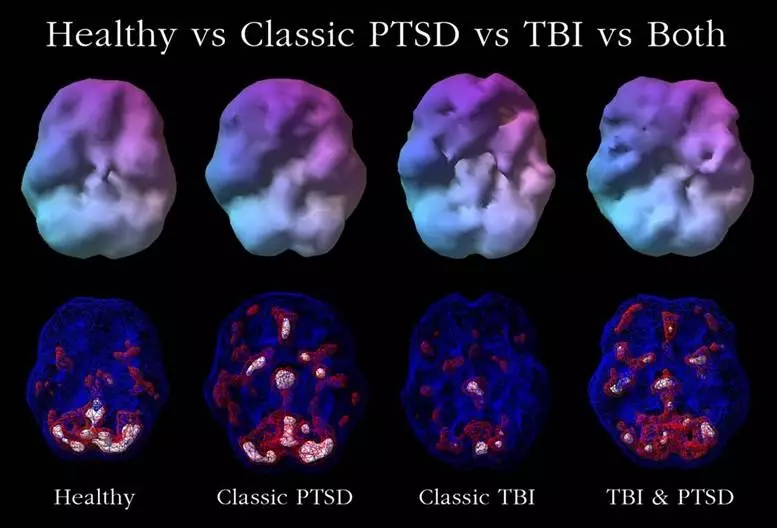 At Amen Clinics, we use leading-edge brain imaging technology to help identify PTSD in the brain. Our comprehensive brain-body approach to treatment involves the least toxic, most effective strategies to heal PTSD, including natural supplements, nutrition, exercise, neurofeedback, helpful forms of therapy, and medication (when necessary)—all personalized for your specific needs.
Don’t suffer from PTSD any longer. Call Amen Clinics at 888-288-9834 or schedule a visit today. Approximately 1 in 30 adults in the United States suffers from post-traumatic stress disorder (PTSD). PTSD can be a disabling condition stemming from a threatening or traumatic life event.
Since our brains are wired to alarm us to the presence of danger, having a physical and psychological response to trauma is normal. But when the upset feelings don’t fade away and turn into painful memories, nightmares and daily battles with anxiety vulnerability, that is the definition of PTSD. When left untreated, PTSD can ruin lives and even lead to depression and suicide.
There are plenty of things you can do to help treat symptoms of PTSD. Here are five ways to help you take back control:
At Amen Clinics, we use leading-edge brain imaging technology to help identify PTSD in the brain. Our comprehensive brain-body approach to treatment involves the least toxic, most effective strategies to heal PTSD, including natural supplements, nutrition, exercise, neurofeedback, helpful forms of therapy, and medication (when necessary)—all personalized for your specific needs.
Don’t suffer from PTSD any longer. Call Amen Clinics at 888-288-9834 or schedule a visit today. Approximately 1 in 30 adults in the United States suffers from post-traumatic stress disorder (PTSD). PTSD can be a disabling condition stemming from a threatening or traumatic life event.
Since our brains are wired to alarm us to the presence of danger, having a physical and psychological response to trauma is normal. But when the upset feelings don’t fade away and turn into painful memories, nightmares and daily battles with anxiety vulnerability, that is the definition of PTSD. When left untreated, PTSD can ruin lives and even lead to depression and suicide.
There are plenty of things you can do to help treat symptoms of PTSD. Here are five ways to help you take back control:
-
Know for Sure
If you’ve suffered emotional trauma but are uncertain if you have PTSD, one way to know for sure is to take a PTSD Self-Assessment Test.
-
Read Success Stories
24.4 million Americans have PTSD which includes soldiers, police officers, victims of physical or sexual assault, and others who have had life-threatening experiences. Many people overcome their PTSD and share their stories. Sometimes hearing how someone else survived a tragedy can reduce the feelings of isolation and shame, while offering reassurance and hope. Read about Colonel Jill’s journey of healing here.
-
Find Community Support
Having a supportive community means that support is just a phone call, email or visit away. Spending time in a positive community of like-minded people is a wonderful way to boost your bliss hormones, such as oxytocin. Focus your energy on people who are positive and engage in healthy habits.
-
Try Proven Therapies
Cognitive behavioral therapy (CBT), a type of talk therapy, not only helps to reduce symptoms of PTSD but also reverses the underlying biology of the disorder within the brain. Eye movement desensitization and reprocessing (EMDR) may help reduce stress from traumatic memories and is particularly useful for people with a history of abuse.
-
Get an Accurate Diagnosis with a Brain Scan
Neuroimaging tools provide an objective measure of PTSD, which leads to better treatment and support. Brain SPECT imaging makes the invisible visible. It shows that symptoms and behaviors are not imaginary, which helps stop the stigma around mental health conditions.
Symptoms of PTSD:
- Intense, distressing memories of the event
- Increased or excessive anxiety
- Problems with sleep
- Anger and irritability
- Depression symptoms
- Social isolation
If you have a loved one who is affected by the symptoms of PTSD, you can support them through the healing process with these 3 tips:
1. Learn all that you can about PTSD
The more you learn about the symptoms and treatment options for PTSD, the better you’ll be able to appreciate what he or she is going through, as well as to keep things in perspective. As part of this learning and support process, you may want to offer to accompany your loved one to their psychiatrist, therapist or VA/clinic visits.2. Be patient and try not to pressure your loved ones into talking
Many people with PTSD find talking about the event(s) nearly impossible. For some, talking before they’re ready can make things worse! Rather than pressing your loved one to share, it’s wise to just let him/her know you’re willing to listen—if and when they’re ready. Above all, be patient. Healing takes time, even if your loved one is getting therapy and is highly motivated to feel better. Just stay positive and provide support; let your friend or family member open up when he/she feels comfortable doing so.3. Take time for fun and connect with a supportive community
Having fun and laughing is one of the best ways to lower stress and release feel-good neurotransmitters. For added benefit, have fun while exercising! Take a walk, ride bikes, go on a hike, dance or do yoga together. If your loved one is prone to isolation, you may suggest that they stay in touch with family and close friends—we are much better together. Isolating oneself while healing from PTSD is like trying to dig out information from a book in a pitch black room while having a strong community means that support is but a phone call, email or visit away. Having PTSD is not a character flaw or a sign of personal weakness. The symptoms of PTSD tell us that there is a biological problem in the brain in response to significant trauma, and the absolute best thing that someone with PTSD can do is seek professional help. If you are ready to regain control over your life or help a loved one do the same, call us today at 888-288-9834 or schedule a visit. Sometimes the barbecuing and vacationing opportunities presented by a three-day weekend for Memorial Day can distract us from the meaning of the moment, which is to remember with gratitude the sacrifice that millions of our countrymen have made when they died while serving in our nation’s defense. Greater love has no one than this: to lay down one’s life for one’s friends. Beyond Memorial day, Amen Clinics celebrates the entire month of June as PTSD Awareness month. In honor of those who have loved us all greatly, we want to focus on new revelations about the brains of combat veterans who suffer from PTSD.How PTSD Affects Our Veterans
PTSD, or posttraumatic stress disorder, is a severe anxiety disorder following a traumatic event. Symptoms can include flashbacks, nightmares, emotional instability and uncontrollable thoughts about the event. It’s a condition that most of us associate with our veterans, but it doesn’t have to be the war that triggers PTSD. It truly does arise from traumatic events. Some Amen Clinics patients who suffer from PTSD have developed the disorder after a car accident or even a divorce. Trauma can change the brain. It’s a complicated disorder with many influencing factors. PTSD patterns can be imaged, and many studies have been conducted in an effort to understand the experiences of our veteran population, as well as to find ways to help them through their struggles. Often, study methods involve some kind of brain activity or task that the veterans are made to do. But what about when symptoms arise spontaneously? What about when there doesn’t seem to be a trigger? If a veteran isn’t provoked, but symptoms still manifest, what does that mean? What is going on with the “resting” brain of a combat veteran with PTSD? A study was published that shows that spontaneous brain activity arises in the brains of those with combat-related PTSD, even when their brains are at rest. Xiaodan Yan, a research fellow at NYU School of Medicine, led the study that took a look at “spontaneous” or “resting” activity in the brains of 104 veterans of combat in the Iraq and Afghanistan wars. Their measurement tool of choice was functional MRI, which measures blood-oxygen levels in the brain. Yan and his team discovered spontaneous brain activity in the amygdala, deep in the temporal lobes, involved with emotional responsiveness. The activity in that region of the brain was significantly higher in the 52 combat veterans with PTSD than in the 52 combat veterans without PTSD.How Amen Clinics Can Help Treat PTSD
At the Amen Clinics, we often we see temporal lobe abnormalities in patients who demonstrate chronic irritability and anger. The significance of this NYU study is its focus on spontaneous brain activity. The subjects were not put through experiences, made to look at aggravating photos or asked to do tasks to get their brains moving. It turns out, you don’t have to get the brain of a PTSD-suffering vet moving – it gets moving all by itself! No wonder they suffer from inexplicable, spontaneous and seemingly irrational upwellings of anxiety, anger, and fear. Neuroimaging tools provide an objective measure of PTSD, which will lead to better treatment and more support for those who are suffering. Thank you, veterans, for your many sacrifices. Amen Clinics knows that PTSD is a serious condition and we understand you may need professional help. Emotional traumas are surprisingly common, but help is available. Contact Amen Clinics today at 888-288-9834 or visit our website to schedule a visit. For many years, Jill didn’t talk about the burning aircraft that chased her in nightmares, or that she had insomnia and couldn’t get more than 3-4 hours of sleep at night. She had brushed the issues off as “a normal part of life now,” like so many others with post-traumatic stress.Brain Warrior Story of Jill Chambers
Fast-forward to 2007, when suicides among service members were skyrocketing. The Chairman of the Joint Chiefs of Staff, whom at the time was Admiral Mike Mullen, asked Jill to serve as the first Special Assistant for Returning Warrior Issues. Jill was solely tasked with pinpointing the “Ground Truth” about transitional challenges facing wounded service members and developing dynamic, real-time strategies and recommendations. Admiral Mullen was committed to ensuring that under his watch, no fallen comrade would be left behind. He empowered Jill to work with that end in mind. In 2008, General George Casey publicly honored Jill for her work and launched the Comprehensive Soldier and Family Fitness Program, focused on the Army’s 5 Dimensions of Strength: Social, Emotional, Family, Spiritual, and Physical. After decades of denial, the U.S. Armed Forces finally started talking about and addressing the psychological well-being of service members and their families.Discovering Help Through Amen Clinics
Once Jill retired in 2009, she realized that she too had PTSD from the events on 9/11/01 and committed three solid months to focusing exclusively on her mental and physical health. When she was introduced to neurofeedback and guided imagery, it completely changed her life. By the end of August, Jill was sleeping better, and her nightmares reduced drastically.
Her newfound passion for integrative healing therapies led her to Dr. Amen’s book, Change Your Brain, Change Your Body. She and her husband committed themselves to practicing The Amen Clinics Method 12 steps of brain healthy living, and it worked. Jill and Michael wanted to be as healthy as possible, so they went to Amen Clinics for full evaluations, including brain SPECT imaging.
Jill was shocked when Dr. Amen showed the results of her SPECT scan. She could now see the parts of her brain where she had a vulnerability to PTSD first-hand. Bringing Dr. Amen’s brain-healthy habits into her life and addressing her PTSD-related insomnia with integrative therapies had resulted in “post-traumatic growth.” The marvel of neuroplasticity had worked in Jill’s favor. She had changed her brain, and by doing so, she also changed her life.
What Can Brain SPECT Imaging Do For You?
Some symptoms of PTSD overlap with those of other conditions, including traumatic brain injury (TBI) where sleep problems, irritability or anger, concentration problems and social isolation are commonly found in both. Because of this, people can be misdiagnosed and given the wrong type of treatment if no one looks at their brain. Amen Clinics understands PTSD, and we are here to help. Contact us today by calling 888-288-9834 or schedule a visit online.
Imagine that you’re in your car, humming along to your favorite tune on the radio while waiting for the traffic signal to change. Suddenly, you see a horrific car accident that leaves some people dead and several others injured. Immediately, your heart starts racing, your breathing gets rapid and shallow, and you feel anxious. These are all typical signs of the human body’s stress response system, also known as the fight-or-flight response. In most people, after witnessing a traumatic event, your system would eventually return to a normal state of relaxation. In some individuals, however, those feelings of fear, anxiety, and horror linger and develop into posttraumatic stress disorder (PTSD). That’s what happened to Miles. After witnessing a traumatic event, feelings of fear, anxiety, and horror may linger and develop into posttraumatic stress disorder (PTSD).PTSD CAUSES AND SYMPTOMS
After the accident, Miles developed PTSD, a condition that will affect an estimated 1 in 11 people during their lifetime. This condition arises in some individuals who experience trauma or witness a traumatic event. Physical, sexual, and emotional abuse are common causes of the condition, as are military combat, natural disasters, mass shootings, and terrorist attacks. For some people, the threat of death, serious injury, or emotional harm—or even a perceived threat—can set the stage for PTSD. People with PTSD tend to recall traumatic events long afterward with flashbacks, uncontrollable thoughts, or nightmares. They often avoid places, people, and things associated with the trauma. It is common to experience anxiety, depression, fearfulness, emotional numbness, anger, and insomnia. Individuals suffering from PTSD are also likely to be easily startled, hypervigilant, or jumpy. This can interfere with relationships, cause problems in your career, and lead to unhealthy coping behaviors such as substance abuse. In some cases, it can ruin your life. Like Miles, people who have PTSD may continually re-experience the trauma as if the past were still alive in the present. Miles, for example, had nightmares about the accident every night. In addition, whenever he saw a car similar to the one that caused the accident, it triggered the same horrible feelings he had experienced in that moment.WHEN THE STRESS RESPONSE GETS STUCK
As humans, we all need to feel safe. When we experience traumas, however, we lose that foundational feeling of safety. The fight-or-flight response that is activated by protective circuitry that strives to keep us safe no longer functions optimally. It gets stuck in overdrive and refuses to calm down. Miles’ danger detector, his stress response alarm system, was on constant fight-or-flight high alert. He felt like he was under threat at all times. Like Miles, many traumatized individuals have fight-or-flight reactions that continue long after the danger has passed. The feeling of danger never abates. It is why the emotional traumas in PTSD are “branded in the brain.”PTSD AND THE BRAIN
Brain SPECT imaging studies reveal that people with PTSD who have suffered emotional trauma or physical abuse tend to have too much activity in certain areas of the brain. The regions where overactivity is seen on SPECT scans include the following:- Deep limbic area (the brain’s emotional center): Overactivity in this region is associated with depression.
- Basal ganglia (the brain’s anxiety center): Too much activity here is linked with increased anxiousness.
- Anterior cingulate gyrus (the brain’s gear shifter): Heightened activity in this area is associated with getting stuck on thoughts and behaviors.
PTSD on SPECT – Before and After Treatment
|
|
TREATING PTSD
The scan on the right shows that if you have PTSD, there is hope for soothing an overactive brain. There are many treatment options that can provide relief. Psychotherapy is a common component of a treatment plan and can be very helpful. Other therapies that can be beneficial include cognitive behavioral therapy (CBT), EMDR (eye movement desensitization and reprocessing), and other trauma-focused therapies. For some people, antidepressant medications may be recommended as part of a treatment plan. Understanding your brain and any co-existing conditions, such as substance abuse, depression, or past head injuries is key to getting the most effective treatment plan. SPECT can be a powerful tool in this regard. Not only does functional brain imaging help identify co-occurring disorders and target treatments to your brain, but it also provides other important benefits. For example, SPECT helps:- Demonstrate that symptoms and behaviors are not imaginary, thereby reducing emotional pain and stigma.
- Families gain a better understanding of what is actually going on in the brain of their loved ones, which increases forgiveness.
- Encourage compliance with treatment plans, which improves outcomes.