

TL;DR
Medically reviewed by Mark Filidei, DO , Amen Clinics
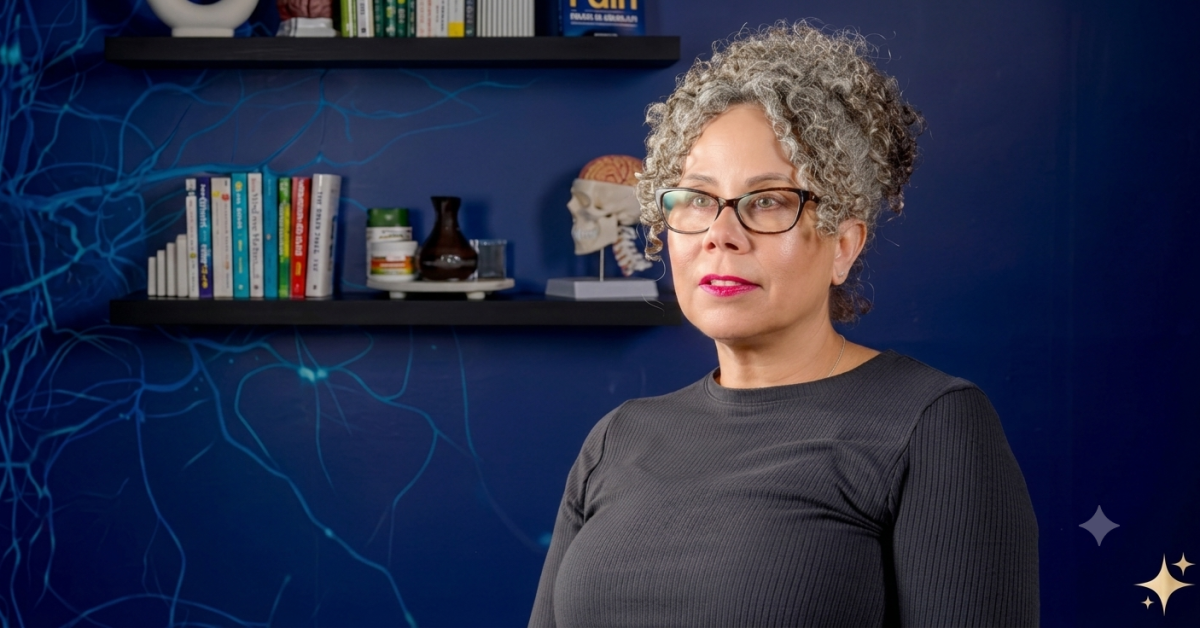
Have you ever felt like something was wrong in your body, but no one could tell you what it was?
Symptoms like brain fog, fatigue, headaches, anxiety, mood swings, and trouble concentrating can sometimes point to hidden issues such as toxic mold exposure. But for many people, the cause isn’t immediately obvious.
That was the reality for Juanita Martin. What began as a series of unexplained physical symptoms quickly spiraled into something much more disruptive. As her condition worsened, she found herself searching desperately for answers. Doctor visits, emergency room trips, and medical tests offered little clarity. No one could pinpoint the cause.
Over time, Juanita began to notice something else. Her symptoms were no longer just physical. They were affecting her mental and emotional well-being too.
Determined to get real answers, she decided enough was enough. She booked a visit to Amen Clinics to take a deeper look at what was happening in her brain.
This is her story or recovery.
“I started experiencing mysterious symptoms… doctors couldn’t figure it out,” says one woman who finally went to Amen Clinics for a brain scan, which showed signs of toxic mold exposure. Understanding the root cause of her issues was the first step in her healing journey.
It was late 2019 when Juanita’s health began to unravel.
“I started experiencing mysterious symptoms… doctors couldn’t figure it out,” she says.
As time went on, the uncertainty about her condition became overwhelming. Not knowing what’s wrong can be just as distressing as the symptoms themselves.
After months of unexplained symptoms and failing to get the right help, something unexpected happened. “I discovered water damage near the baseboard of my floor. They discovered mold,” Juanita recalls. Suddenly, her world flipped upside down.
She realized she was experiencing mold toxicity symptoms. “I’ve heard of people having toxic mold exposure, but I didn’t know how, physiologically, it was affecting the body. I’m severely allergic to mold,” Juanita explains.
Juanita and her husband were forced to leave their home for five months so that the mold could be fully remediated.
There are so many types of molds. What is toxic mold?
Toxic mold refers to certain types of fungi that produce poisonous substances called mycotoxins. These molds often grow in damp, water-damaged environments, such as homes with leaks, flooding, or poor ventilation.
In terms of brain health, research suggests that exposure to toxic mold may trigger inflammation in the brain, interfere with the brain’s ability to produce healthy new brain cells, and contribute to problems with memory, concentration, mood, and emotional well-being.
Toxic mold exposure has been linked to a range of symptoms, including:
Although black mold (Stachybotrys chartarum) is the most well-known, many types of mold can produce harmful toxins.
A mold allergy occurs when the immune system overreacts to mold spores that are normally harmless to most people. Symptoms can include coughing, sneezing, itchy or watery eyes, congestion, wheezing, skin irritation, and trouble breathing.
Mold allergies are surprisingly common. Research estimates that between 3 and 10 out of every 100 people have them. People with asthma, respiratory conditions, or a family history of allergies may be at greater risk.
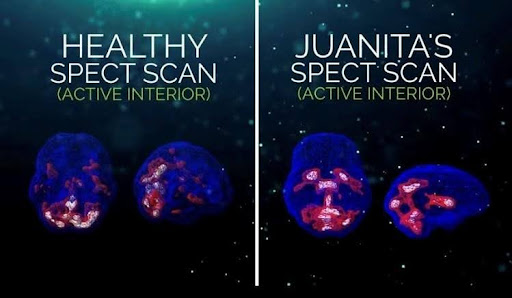
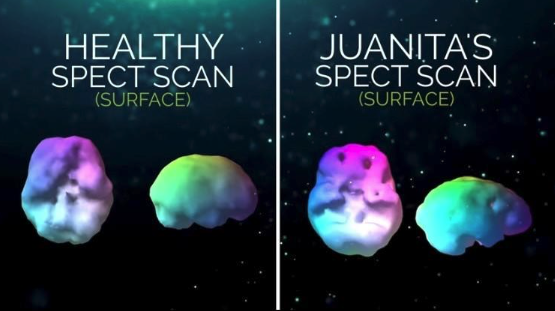
Juanita’s active brain scans show overactivity in the emotional and fear centers of the brain. In the surface scans, there are signs of low blood flow in the prefrontal cortex and a “scalloping” appearance consistent with toxic exposure. When seeing this pattern on SPECT scans, it leads Amen Clinics physicians to ask why the brain looks toxic and what might be causing it.
With this new insight, Juanita and her husband were able to begin personalized treatment plans designed to support their brains. By increasing blood flow and addressing the root cause, they were finally able to move forward into a healthier, happier chapter of their lives.
One of the most transformative moments came during brain SPECT imaging.
SPECT (single photon emission computed tomography), is a specialized brain imaging technology that measures blood flow and activity patterns in the brain.
At Amen Clinics, SPECT scans are used to help identify areas of the brain that may be overactive or underactive, providing insights that can guide more personalized treatment plans for mental health, cognitive function, and behavioral issues.
In Juanita’s case, seeing her SPECT scan had a meaningful impact. For the first time, she could see what was happening in her brain as a result of the mold exposure. “I felt validated that it was literally in my head, and I wasn’t going crazy,” she says.
This is a powerful turning point for many patients. Brain imaging provides objective evidence of how the brain is functioning, helping to explain symptoms that may otherwise feel confusing or dismissed.
Research and clinical experience show that, in addition to toxic exposure, SPECT imaging can reveal brain patterns linked to other conditions including:
Instead of guessing based on symptoms alone, Amen Clinics’ clinicians take a whole-body approach to treatment that is based on looking at the entire person and all the factors that impact brain health and mental well-being.
Our clinicians use SPECT scan results, plus a personal health history that explores lifestyle factors, and other clinical assessments, which sometimes may require additional lab work, to closely examine all contributing factors and fully understand what might be happening in the body and brain.
Targeted treatment plans are then created based on what the brain actually needs.
Related: Toxic Mold Syndrome: “It Was Like I Lost My Personality”
For Juanita, the effects of exposure didn’t stop at physical toxic mold symptoms.
The ordeal also impacted her marriage.
Before understanding the root cause, she and her husband struggled in their interactions. But brain-based insights changed how they saw each other and reduced their marital conflict.
“It was like this little boy and this little girl trying to interact in adult bodies,” Juanita explains.
That shift in perspective created space for empathy, compassion, and healing.
When you understand that behavior is often driven by brain function, not character flaws, it becomes easier to:
This is one of the most powerful lessons from brain health work: relationships improve when understanding increases.
Feeling hope for the first time, the feeling of being stuck dissipated. Juanita and her husband began to move forward together. Juanita recalls that she felt, “We can walk through this together.”
With guidance and support, they learned how to:
Brain health and mental health issues don’t exist in isolation. They affect families, relationships, and daily life.
The collaborative healing process was powerful for the Martins.
With treatment at Amen Clinics, Juanita began to notice meaningful changes over time. “My flare-ups are less… I’m listening to my body and what my brain needs,” she says. She now has a brain health tool kit that she uses.
Her recovery wasn’t instant, but it has proved to be real and lasting.
Healing from toxic exposure and brain dysfunction often involves:
This personalized, whole-person approach is key to long-term improvement.
Juanita’s journey didn’t end with treatment. It truly began a new chapter in her life filled with connection and purpose.
She joined the Amen Clinics Brain Warriors Alumni Network, a community where patients share experiences, encouragement, and hope.
“I want other people to know… they don’t have to stay stuck,” she says.
By hearing others’ stories and sharing her own, she feels a deep sense of gratitude and purpose that has enriched her life.
While Juanita’s healing began as symptom relief, it has become so much more.
One theme stood out throughout Juanita’s experience at Amen Clinics: safety. She explains, “It was a safe space. I felt at home. I felt safe.”
When you’re dealing with complex, misunderstood symptoms, feeling safe and supported can mean everything.
At Amen Clinics, the goal is not just to treat symptoms, but to create an environment where healing can truly begin.
If you’re struggling with unexplained symptoms, mood changes, or cognitive issues, this story carries an important message: you are not alone, and you are not out of options.
Sometimes, the root cause lies deeper than standard testing reveals. Whether it’s toxic exposure, brain dysfunction, or another underlying issue, identifying the cause is the first step toward healing.
As this patient’s journey shows:
By addressing the root causes of symptoms, including environmental toxic mold exposure, Amen Clinics provides a comprehensive, science-backed path to recovery.
With tools like brain SPECT imaging, personalized treatment plans, and ongoing support, patients can move from confusion and frustration to clarity and hope.
Toxic mold refers to certain types of fungi that produce harmful substances called mycotoxins. These molds commonly grow in damp, humid, or water-damaged environments.
Exposure to toxic mold can trigger inflammatory responses that directly affect brain regions responsible for memory, emotion, and coordination. Although black mold is the most well-known, many different mold species can produce toxins that affect health.
Toxic mold exposure can affect both the body and brain. Symptoms of mold toxicity may include brain fog, fatigue, headaches, memory problems, anxiety, mood swings, trouble concentrating, sleep issues, chronic inflammation, and increased sensitivity to stress.
In some people, symptoms can become severe enough to interfere with relationships, work, and daily functioning.
Yes. Research and clinical experience suggest that toxic mold exposure may contribute to mental health symptoms such as anxiety, depression, irritability, panic, mood changes, and cognitive difficulties.
Because mold can impact brain function, many people experience emotional and psychological symptoms in addition to physical ones.
At Amen Clinics, evaluations include brain SPECT imaging, detailed clinical assessments, and a review of environmental, medical, and lifestyle factors. SPECT scans measure blood flow and activity patterns in the brain, helping clinicians identify areas that may have been affected by toxic exposure.
They then create personalized treatment plans to heal the brain in the areas affected and strengthen brain health.
In many cases, yes. The brain has an incredible ability to heal and change when underlying causes are addressed.
Recovery may involve removing environmental toxins, supporting detoxification pathways, improving blood flow to the brain, optimizing nutrition and sleep, reducing inflammation, and following a personalized treatment plan designed to support brain health.
Harding CF, Pytte CL, Page KG, Ryberg KJ, Normand E, Remigio GJ, DeStefano RA, Morris DB, Voronina J, Lopez A, Stalbow LA, Williams EP, Abreu N. Mold inhalation causes innate immune activation, neural, cognitive and emotional dysfunction. Brain Behav Immun. 2020 Jul;87:218-228. doi: 10.1016/j.bbi.2019.11.006. Epub 2019 Nov 18. PMID: 31751617; PMCID: PMC7231651.
López Couso VP, Tortajada-Girbés M, Rodriguez Gil D, Martínez Quesada J, Palacios Pelaez R. Fungi Sensitization in Spain: Importance of the Alternaria alternata Species and Its Major Allergen Alt a 1 in the Allergenicity. J Fungi (Basel). 2021 Aug 3;7(8):631. doi: 10.3390/jof7080631. PMID: 34436170; PMCID: PMC8398619.