

TL;DR
Medically reviewed by Kabran Chapek, ND, Amen Clinics
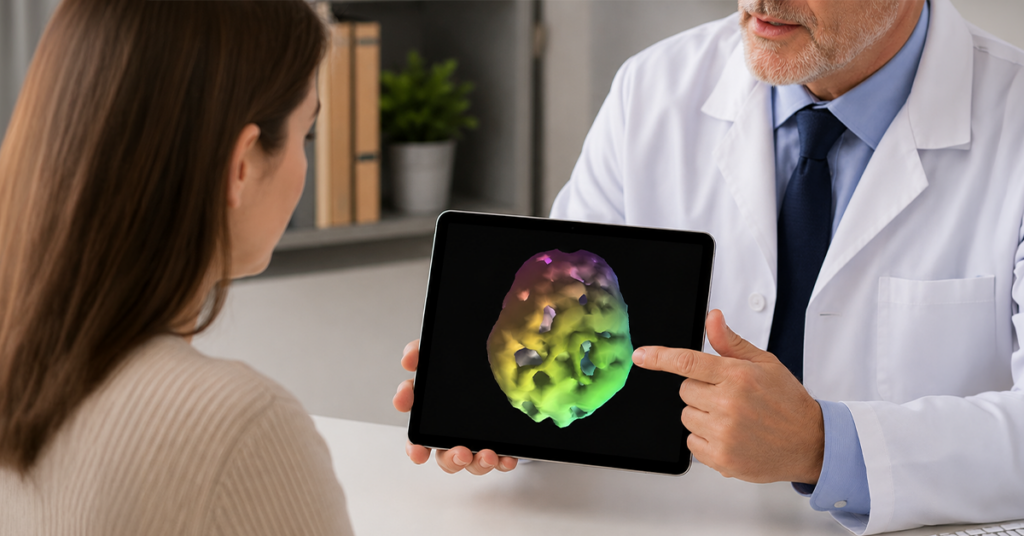
You hit your head. Maybe it was a car accident, a fall, or a collision during a game. You get checked out, even have a scan, and you’re told everything looks normal.
But months later, something still isn’t right.
You wonder, if my brain scan was normal, why do I still feel this way?
As it turns out, conventional imaging tools are designed to look at the structure of the brain, but they can miss functional changes that result from mild traumatic brain injury.
Researchers are now exploring functional imaging and asking can a SPECT scan detect a concussion?
New research (in preparation for publication) by Dr. Daniel Amen and colleagues suggests that brain SPECT imaging measures patterns of brain blood flow and activity, detecting “hidden fingerprints” associated with concussions. It appears that mild traumatic brain injuries may leave behind distinct patterns of brain activity that standard scans can’t detect. This finding may help explain why some people continue to struggle with concussion symptoms long after they’ve been told they’re fine.
In this blog, we’ll explore how brain imaging is changing what we know about concussions, and why getting the right kind of information could make all the difference in recovery.
New research suggests that concussions may leave behind ‘hidden fingerprints’ in the brain. These patterns can help explain why some people continue to struggle long after they’ve been told they’re fine.
The word “mild” can be one of the most misleading terms in brain-injury medicine. It refers to the classification of the injury at the time it occurs, and not necessarily about the severity or duration of what follows. That distinction matters more than most people realize. For a meaningful percentage of people, a mild TBI can set off weeks, months, or even years of life disruption.
Research suggests that approximately 69 million traumatic brain injuries occur globally each year, with around 80 percent classified as “mild”, making this one of the most widespread and underappreciated neurological concerns in public health today. Interestingly, there’s a reason for that.
“Mild” refers to the severity of the initial injury, not the intensity of recovery. Someone can walk away from a concussion without losing consciousness and still experience weeks, months, or years of cognitive and emotional disruption.
According to clinical research, a mild TBI is defined by the following terms:
What that criteria cannot predict is whether your brain will recover seamlessly or whether functional disruptions will last long after the initial injury window closes. For many people, “mild” describes the event instead of the experience that follows.
Post-concussion symptoms can impact virtually every area of your daily life.
Common lingering issues can include:
These symptoms don’t just fade for everyone either. A 2025 systematic review published in JAMA Network Open found that up to 30 percent of adults with mild traumatic brain injury continue to experience symptoms well beyond the initial recovery period. Another study found that nearly 50 percent of patients with mild TBI were still experiencing symptoms one year after injury.
Early factors like thinking and memory problems, a history of anxiety or depression, having a sleep disorder, or losing consciousness at the time of injury can increase the risk of ongoing issues at one, three, and six months.
A 2022 scoping review found a two-way connection between lingering concussion symptoms and mental health challenges, including depression, anxiety, and difficulty regulating emotions.
Unfortunately, many people with mild TBI are told their scans look normal and that their symptoms will resolve with time, only to find themselves still struggling months later.
The brain is impacted by deeper issues that can be hard to understand or articulate, or detect with traditional scans.
It’s easy to overlook just how delicate your brain is. Although it’s powerful and remarkably resilient, it is comprised of soft tissue the consistency of soft butter and housed in a protective hard, rigid skull. But this protective “shell” is filled with sharp bony ridges. In mild traumatic brain injuries, your brain sloshes against the hard, rigid skull, causing bruising, tearing, and functional damage that traditional scans generally do not pick up.
It’s a leading clinical problem that researchers who specialize in brain health are actively working to address. When it comes to non-traditional, functional brain imaging for mild TBI, clinicians are more frequently asking, can SPECT detect mild traumatic brain injury?
It appears that SPECT (single photon emission computerized tomography) is uniquely suited to detect mild brain injuries that structural imaging misses.
CT and MRI scans are powerful tools, but they’re designed to detect structural damage like bleeding, swelling, or fractures. In many mild TBI cases, these scans come back normal because the injury is not structural but functional. Research confirms that conventional imaging can often fail to detect subtle brain changes in mTBI.
SPECT imaging measures blood flow in the brain, helping show which areas are more active and which may be underperforming. Because brain cells rely on a steady supply of oxygen-rich blood to function, changes in blood flow can reflect how well different parts of the brain are working. Healthy cerebral blood flow is also important for healing following a brain injury.
A 2021 study showed that regional blood flow is closely linked to brain activity and can reveal functional problems even when standard scans look normal.
At Amen Clinics, this functional perspective is central. While structural scans may miss post-concussion abnormalities, SPECT can highlight patterns of overactivity or underactivity that align with symptoms.
If your scan looks “normal,” but your brain doesn’t feel normal, the disconnect can be frustrating and feel invalidating. Functional SPECT imaging offers another lens that focuses on how the brain works, not just how it looks.
When your brain is struggling on a functional level and the reason behind your struggle goes undiagnosed, you’re left without a roadmap. A functional scan like SPECT may provide different information that could change the conversation and your treatment plan entirely. So, what does a concussion look like on a SPECT scan?
The evidence that SPECT can detect meaningful functional changes after mild TBI has been building for years. SPECT imaging of mild TBI reveals replicated blood flow (perfusion) patterns that match specific symptom clusters, even months or years later. These ‘hidden fingerprints’ explain why some people never fully recover. Early detection could change everything.
In the new study mentioned earlier, Dr. Amen and researchers analyzed SPECT scans from 169 adults with mild TBI and found widespread, reproducible differences in brain activity across brain regions compared to healthy individuals. These findings point to a clear and measurable “signature” of concussion in the brain that may offer deeper insight into lingering symptoms and more personalized paths to care.
Studies have identified recurring abnormalities in cerebral blood flow related to mild TBI, particularly in frontal, temporal, parietal, and occipital regions. These findings suggest that mild TBI is not random and often follows recognizable patterns.
Importantly, these abnormalities aren’t limited to the immediate aftermath. Research shows that altered blood flow can persist months or years after the injury, even when CT scans are normal.
Longitudinal research shows that positive predictive value actually increased from 59 percent shortly after trauma to 95 percent at one-year follow-up. Positive predictive value describes how likely it is that a positive test result accurately reflects the presence of a condition. Essentially, this means SPECT can become more diagnostically reliable over time.
A 2022 study in Frontiers in Neurology examined patients with chronic mTBI symptoms lasting longer than three months and found that SPECT imaging identified hypoperfused brain regions that corroborated their functional limitations, even in cases where CT and MRI had shown no changes.
Most think of concussion as a visible bruise. However, it is more accurate to think of the injury as having left a signature pattern of how the brain communicates and processes information. The signature patterns or “hidden fingerprints” are the recognizable patterns of altered blood flow that correspond to brain function and where it struggles with daily life tasks. These changes may be invisible on structural imaging, but measurable on functional imaging.
Brain imaging findings often mirror real-life symptoms and can give you and your doctor a place to start creating a personalized treatment plan with your brain in mind.
The brain is not homogenous but rather an intricate network of interconnected regions, each contributing to different aspects of cognition, emotion, and physical function. When critical blood flow is disrupted in one region versus another, the downstream effects on your daily life can vary dramatically.
Understanding these connections is part of what makes functional imaging so valuable and why Amen Clinics’ whole-body approach to concussion care begins by looking at the brain directly rather than guessing from symptoms alone.
The region of the brain where blood flow is disrupted may line up with the specific cluster of symptoms a person is experiencing.
Research supports region-specific dysfunction in mTBIs and poor functional outcomes over time. Your brain is highly interconnected and unique variation is significant, but it offers a useful clinical framework to guide you. Here’s what that could look like:
A review of brain regions and associated post-concussion symptoms published in Frontiers in Neurology noted that specific structures play distinct roles in the symptom profiles experienced after concussion. It referred to regions ranging from the amygdala and hippocampus to the insula, frontal lobes, and vestibular pathways.
No two brains are identical. Your brain is unique to you, which makes your healing unique too. This might explain why one person can bounce back quickly while another struggles for months.
Here are some factors that affect resilience:
Meta-analysis research on persistent symptoms after concussion confirmed that factors such as premorbid anxiety, prior depression, and acute cognitive symptoms all interact to shape the recovery timeline, independently of how severe the initial injury appeared.
Too often individuals can feel like persistent symptoms mark some sort of personal failure in their healing, or they ignore them thinking they’ll resolve over time. A more accurate assessment is to interpret ongoing issues as a need for professional attention and proactively respond by seeking the right care.
Leaving symptoms unaddressed can worsen your mental health. A 2022 systematic review found that people with persistent post-concussion symptoms had fourfold higher odds of experiencing depressive symptoms, underscoring the real mental health burden that unresolved brain dysfunction shares.
Addressing symptoms as a brain-health issue rather than a behavioral or psychological one can lead to better outcomes as it treats root causes. Research on treatments for post-concussion syndrome has found that cognitive training, psychoeducation, and cognitive behavioral therapy all show some effectiveness, particularly when treatment is targeted to your specific symptom profile.
Structural scans are not misleading; in many cases, there is no visible structural damage to detect. However, even thorough evaluations may overlook meaningful changes in brain function. This highlights a critical distinction: the absence of structural abnormalities does not necessarily indicate normal brain function.
A normal CT or MRI after a mild TBI does not rule out functional problems, and it does not predict a symptom-free recovery.
A 2022 study in Frontiers in Neurology noted specifically that conventional imaging frequently shows no changes after mTBI, even in patients with chronic symptoms lasting more than three months. It also showed that functional imaging tools like SPECT can add clinically meaningful information precisely in those cases.
From a clinical standpoint, a negative structural scan is reassuring that there is no emergency, but it should not be interpreted as a clean bill of functional brain health.
One of the most difficult experiences for people living with post-concussion syndrome is feeling invisible.
The injury may not show on a standard scan or may not be an obvious physical disability.
Oftentimes, people are expected to function normally while their brain is still struggling in ways that are completely real but not detectable like a broken arm or other injury.
As research has noted, some patients with mTBI may go a full year before symptoms appear. Others appear recovered to others, while experiencing cognitive dysfunction. The invisibility of the injury can compound the burden as well.
Struggling to focus during meetings. Forgetting simple tasks. Feeling emotionally reactive or disconnected from your friends and family. These aren’t small inconveniences. One concussion can reshape your entire life and that of those around you.
Cognitive and behavioral difficulties after TBI have been documented to interfere with participation in meaningful activities and create significant challenges at work, in school, and in interpersonal relationships.
A 2020 review published in Frontiers in Psychology noted that the effects of a single TBI may persist for years and can limit patients through somatic complaints, cognitive impairment, and affective sequelae. Patients with mild TBI may also struggle with social cognition disturbances, attention deficits, memory problems, and emotional instability.
Knowing what to pay attention to in the weeks and months after a head injury can be confusing. You might assume that if the emergency room cleared you, that means you’re fine; but the days and weeks following a concussion are when a great deal of functional recovery (or disruption) unfolds.
Here are a few common symptoms that deserve closer monitoring and follow-up if they don’t resolve within the expected 14-day window:
If these symptoms linger, especially past the three-month mark, professional follow-up care is essential for healing.
If you’re still experiencing post-concussion symptoms weeks or months after your injury, the most important step is also the most straightforward: take it seriously and get help from a qualified medical professional.
Persistent symptoms after mild TBI are not rare, and they are not something to simply “push through.”
Your experience is valid. Symptoms can reflect real brain dysfunction and it’s best to listen to your brain health doctor when it comes to a brain injury.
To provide a clearer picture of what you need, a comprehensive assessment may include history, cognitive testing, and potentially imaging.
At Amen Clinics, brain health is viewed through a whole-body approach, integrating biology, psychology, lifestyle, and environment with precision medicine.
Related: Emotional Concussions The Silent Brain Injury You Might Have
Traditional approaches to concussion often rely heavily on reported symptoms, which can leave important questions unanswered about what is happening in the brain. At Amen Clinics, the focus shifts to understanding brain function directly, offering a more complete picture of why symptoms may persist.
With more than 30 years of clinical experience and the world’s largest database of brain SPECT scans, this approach is grounded in objective data. By identifying patterns of brain activity, clinicians can better connect symptoms to underlying changes and develop more targeted, individualized care plans.
Amen Clinics emphasizes a holistic approach to psychiatry that looks at optimizing the brain. Care is guided by brain imaging and a comprehensive evaluation, including personal history, lifestyle factors, and overall health.
Rather than relying on medication as the only solution, treatment plans may incorporate targeted lifestyle interventions such as nutrition, exercise, sleep optimization, stress management, and other therapeutic strategies.
Medication is used when appropriate, but always as part of a broader, individualized plan. This approach helps identify patterns and connections that may be missed in symptom-based care alone, leading to more personalized and effective treatment.
SPECT imaging provides a view of how the brain is functioning by measuring blood flow and activity patterns. This functional perspective can reveal changes that are not visible on structural scans like MRI or CT.
A 2024 study found that individuals with mild traumatic brain injury may have normal MRI findings while still experiencing measurable disruptions in brain activity, particularly in regions involved in attention, memory, and emotional regulation. By identifying these patterns, SPECT imaging can help explain persistent symptoms and support more targeted clinical decision-making.
Using precision medicine, treatment is tailored to the individual instead of only the diagnosis. This may include natural ways to treat mental health conditions alongside medical care.
When it comes to mild traumatic brain injury, one of the biggest challenges isn’t just the injury itself, it’s the delay in understanding what’s really happening.
When symptoms are dismissed or scans appear normal, people are often left without answers, and that can lead to months of confusion, frustration, and ineffective treatment.
Early detection can provide clarity and better outcomes. With clearer insight into how the brain is functioning, clinicians can make more informed decisions and patients can move forward with a more targeted, thoughtful plan for recovery.
Identifying functional changes early may help clinicians tailor support more effectively with a more accurate picture of what they’re dealing with and a more rational foundation for the decisions that follow. While this can make a better outcome more likely, it’s important to note that it does not guarantee it.
Without clear answers, many patients cycle through providers and treatments without resolution. Functional SPECT imaging can help clinicians identify areas of brain dysfunction and develop more targeted clinical interventions. That’s the kind of precision medicine approach that Amen Clinics has long championed.
It’s an unfortunate truth that people often downplay head injuries. But when a patient can see the brain dysfunction associated with their symptoms on a scan, there’s a sense of validation, a reduction in shame, and an increase of motivation to do what it takes to heal.
The research on post-concussion syndrome consistently highlights that early management of physical, cognitive, and emotional symptoms may reduce long-term morbidity.
A concussion does not have to look dramatic to disrupt brain health. Even mild traumatic brain injury can lead to lasting changes in how the brain functions, particularly in blood flow patterns that may correspond to real, ongoing symptoms.
Dr. Amen’s new research helps illustrate this more clearly. The findings show that mild TBI can leave behind consistent patterns of altered brain activity that are linked to specific symptom clusters, even months or years after the injury.
This growing body of work reinforces an important point: persistent symptoms following a mild TBI are not random or imagined. They may reflect measurable changes in brain function, which are often missed by traditional imaging but can be seen through functional approaches like SPECT.
Sometimes it can. CT and MRI may miss subtle functional problems in mild TBI, while SPECT may detect abnormal blood-flow patterns that align with symptoms.
Different scans serve different purposes. CT and MRI evaluate structure, while SPECT focuses on function and activity patterns in the brain. Sometimes functional brain imaging such as SPECT can catch non-structural brain dysfunction, which tends to be more common with concussions.
Yes. Research shows that some people continue to exhibit brain changes and symptoms long after the initial injury for longer periods of time.
Recovery varies due to factors like brain region involvement, prior injuries, inflammation, and overall brain health. A treatment plan that addresses root causes may lead to better outcomes.
SPECT highlights blood flow and activity, revealing areas of underactivity or imbalance that may explain lingering symptoms.
About the Reviewer
Dr. Kabran Chapek has been a staff physician at Amen Clinics Seattle Metro Area since 2013. A graduate of Bastyr University, he specializes in functional and integrative medicine, with particular expertise in Alzheimer’s disease, dementia, traumatic brain injury (TBI), PTSD, and anxiety disorders. He is the founding president of the Psychiatric Association of Naturopathic Physicians and author of Concussion Rescue: A Comprehensive Program to Heal Traumatic Brain Injury, which shares the brain-health strategies he uses to help patients recover and thrive.
Norris S, Salgado F, Murray S, Amen D, Keator DB. Replicated Regional Perfusion Signatures of Mild Traumatic Brain Injury and Their Association With Symptom Domains. 2026. [In preparation for publication.]
Abstract:
Mild traumatic brain injury is a prevalent global health concern, often resulting in persistent cognitive and affective symptoms despite normal structural imaging.
We examined resting-state Single Photon Emission Computed Tomography scans from 169 adults with isolated mild traumatic brain injury (divided into two independent samples, N = 84 and 85) and 76 healthy controls to characterize regional perfusion differences, evaluate their reproducibility, and assess relationships with patient-reported symptoms.
Voxelwise whole-brain analyses identified widespread hypoperfusion across frontal, temporal, parietal, occipital, subcortical, and cerebellar regions, along with hyperperfusion in anterior cingulate, cerebellar, sensorimotor, and visual areas, with replicated patterns across both samples. Random Forest classifiers trained on replicated regions distinguished mild traumatic brain injury from controls with accuracies up to 88% (AUC = 0.81-0.95). Symptom-specific analyses revealed that anhedonia corresponded to altered perfusion in affective, reward, and sensorimotor regions; attention and executive deficits mapped to posterior cerebellar hypoactivation; and impaired cognitive flexibility was associated with reduced activity in right cerebellar Crus I, right inferior frontal gyrus, and right middle temporal gyrus.
These results indicate that post-mild traumatic brain injury symptoms arise from distributed dysfunction across multiple brain regions, reflecting a combination of hypo- and hyperperfusion, and highlight the value of functional imaging for mapping symptom-brain relationships that may inform more targeted clinical interventions.
Naumenko, Y., Yuryshinetz, I., Zabenko, Y., & Pivneva, T. (2023). Mild traumatic brain injury as a pathological process. Heliyon, 9(7), e18342. https://doi.org/10.1016/j.heliyon.2023.e18342
Ginsburg J, Smith T. Traumatic Brain Injury. [Updated 2025 Feb 17]. In: StatPearls [Internet]. Treasure Island (FL): StatPearls Publishing; 2026 Jan-. Available from: https://www.ncbi.nlm.nih.gov/books/NBK557861/
McIntosh, S. J., Vergeer, M. H., Galarneau, J. M., Eliason, P. H., & Debert, C. T. (2025). Factors Associated With Persisting Symptoms After Concussion in Adults With Mild TBI: A Systematic Review and Meta-Analysis. JAMA network open, 8(6), e2516619. https://doi.org/10.1001/jamanetworkopen.2025.16619
Theadom A, Parag V, Dowell T, McPherson K, Starkey N, Barker-Collo S, Jones K, Ameratunga S, Feigin VL; BIONIC Research Group. Persistent problems 1 year after mild traumatic brain injury: a longitudinal population study in New Zealand. Br J Gen Pract. 2016 Jan;66(642):e16-23. doi: 10.3399/bjgp16X683161. PMID: 26719482; PMCID: PMC4684031.
Sheldrake, E., Al-Hakeem, H., Lam, B., Goldstein, B. I., Wheeler, A. L., Burke, M., Dunkley, B. T., Reed, N., & Scratch, S. E. (2022). Mental Health Outcomes Across the Lifespan in Individuals With Persistent Post-Concussion Symptoms: A Scoping Review. Frontiers in neurology, 13, 850590. https://doi.org/10.3389/fneur.2022.850590
Koerte IK, Hufschmidt J, Muehlmann M, et al. Advanced Neuroimaging of Mild Traumatic Brain Injury. In: Laskowitz D, Grant G, editors. Translational Research in Traumatic Brain Injury. Boca Raton (FL): CRC Press/Taylor and Francis Group; 2016. Chapter 13. Available from: https://www.ncbi.nlm.nih.gov/books/NBK326714/
Kim, C. M., Alvarado, R. L., Stephens, K., Wey, H. Y., Wang, D. J. J., Leritz, E. C., & Salat, D. H. (2020). Associations between cerebral blood flow and structural and functional brain imaging measures in individuals with neuropsychologically defined mild cognitive impairment. Neurobiology of aging, 86, 64–74. https://doi.org/10.1016/j.neurobiolaging.2019.10.023
Rauchman, S. H., Albert, J., Pinkhasov, A., & Reiss, A. B. (2022). Mild-to-Moderate Traumatic Brain Injury: A Review with Focus on the Visual System. Neurology international, 14(2), 453–470. https://doi.org/10.3390/neurolint14020038
Raji, C. A., Tarzwell, R., Pavel, D., Schneider, H., Uszler, M., Thornton, J., van Lierop, M., Cohen, P., Amen, D. G., & Henderson, T. (2014). Clinical utility of SPECT neuroimaging in the diagnosis and treatment of traumatic brain injury: a systematic review. PloS one, 9(3), e91088. https://doi.org/10.1371/journal.pone.0091088
Gosset A, Wagman H, Pavel D, Cohen PF, Tarzwell R, Bruin S, Siow YH, Numerow L, Uszler J, Rossiter-Thornton JF, McLean M, Lierop M, Waisman Z, Brown S, Mansouri B, Basile VS, Chaudhary N and Mehdiratta M (2022) Using Single-Photon Emission Computerized Tomography on Patients With Positive Quantitative Electroencephalogram to Evaluate Chronic Mild Traumatic Brain Injury With Persistent Symptoms. Front. Neurol. 13:704844. doi: 10.3389/fneur.2022.704844
Hayes, J. P., Bigler, E. D., & Verfaellie, M. (2016). Traumatic Brain Injury as a Disorder of Brain Connectivity. Journal of the International Neuropsychological Society : JINS, 22(2), 120–137. https://doi.org/10.1017/S1355617715000740
Danielli, E., Simard, N., DeMatteo, C. A., Kumbhare, D., Ulmer, S., & Noseworthy, M. D. (2023). A review of brain regions and associated post-concussion symptoms. Frontiers in neurology, 14, 1136367. https://doi.org/10.3389/fneur.2023.1136367
McIntosh, S. J., Vergeer, M. H., Galarneau, J. M., Eliason, P. H., & Debert, C. T. (2025). Factors Associated With Persisting Symptoms After Concussion in Adults With Mild TBI: A Systematic Review and Meta-Analysis. JAMA network open, 8(6), e2516619. https://doi.org/10.1001/jamanetworkopen.2025.16619
Lambert, M., Sheldrake, E., Deneault, A. A., Wheeler, A., Burke, M., & Scratch, S. (2022). Depressive Symptoms in Individuals With Persistent Postconcussion Symptoms: A Systematic Review and Meta-Analysis. JAMA network open, 5(12), e2248453. https://doi.org/10.1001/jamanetworkopen.2022.48453
Heslot, C., Azouvi, P., Perdrieau, V., Granger, A., Lefèvre-Dognin, C., & Cogné, M. (2022). A Systematic Review of Treatments of Post-Concussion Symptoms. Journal of clinical medicine, 11(20), 6224. https://doi.org/10.3390/jcm11206224
De Koning ME, Scheenen ME, Van Der Horn HJ, Spikman JM, Van Der Naalt J. From ‘miserable minority’ to the ‘fortunate few’: the other end of the mild traumatic brain injury spectrum. Brain Inj. 2018;32(5):540-543. doi: 10.1080/02699052.2018.1431844. Epub 2018 Feb 1. PMID: 29388851.
Calvillo M and Irimia A (2020) Neuroimaging and Psychometric Assessment of Mild Cognitive Impairment After Traumatic Brain Injury. Front. Psychol. 11:1423. doi: 10.3389/fpsyg.2020.01423
Koziarz, Alex & Koziarz, Frank & Shen, Rui & Gopee-Ramanan, Prasaanthan & Black, Sandra & Worsley, Daniel & Chan, Ian & Streiner, David & Zukotynski, Katherine. (2024). Diagnostic Accuracy of SPECT for Mild Traumatic Brain Injury: A Systematic Review and Meta-analysis. Clinical nuclear medicine. 49. 10.1097/RLU.0000000000005328.
Norris, S., Salgado, F., Murray, S., Amen, D., & Keator, D. B. (in preparation). Replicated regional perfusion signatures of mild traumatic brain injury and their association with symptom domains.