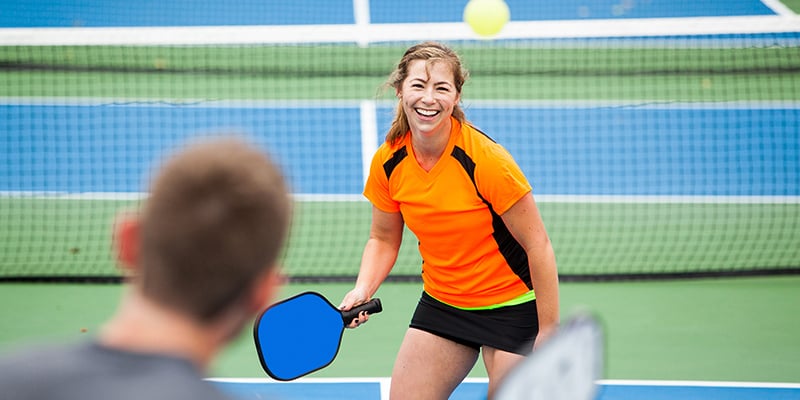
Pickleball—a mix of tennis, paddleball, and table tennis—has been called the fastest-growing sport in America with 4.2 million players in 2020, up 21.3% from 2019. If you’re one of the people caught up in the pickleball craze or if you’ve been thinking about trying the sport, you may appreciate its physical benefits. But did you know this popular sport also provides a host of brain benefits? Here are 7 ways pickleball boosts your mental, emotional, and cognitive health.
7 MENTAL HEALTH AND BRAIN BENEFITS OF PICKLEBALL
1. Improves blood flow to the brain.
Running around on a pickleball court gets your heart pumping, which boosts blood flow to the brain. This increases the supply of oxygen, glucose, and nutrients to the organ between your ears, enhancing overall brain health. In particular, heart-pounding exercise boosts blood flow to the
prefrontal cortex (PFC), an area of the brain involved with attention, planning, and impulse control. A healthier PFC means better focus, decision-making, and follow-through. Typically, these traits add up to a happier, more fulfilling life.
2. Enhances cerebellum function.
The footwork and hand-eye coordination required to play pickleball activate the
cerebellum, an area at the back bottom of the brain involved in cognitive flexibility and processing speed. Heightened activity of the cerebellum boosts these mental functions.
3. Increases gray matter.
Research from Brazil shows that physical activity that requires planning—such as deciding whether to smash the ball or dink it softly over the net—and complex movements result in higher gray matter volume. More gray matter volume is associated with increased ability to evaluate rewards and consequences, according to findings in a
2012 study in the
Journal of Cognitive Neuroscience.
4. Strengthens the hippocampus.
Getting your body moving protects the hippocampus, structures located within the temporal lobes that are involved in the formation of memories. A
2011 study in
PNAS found that aerobic exercise like pickleball increases the size of the hippocampus and improves memory. Pickleball also gives your memory a workout by making players remember the score and whose serve it is. Sounds simple, but scoring in this sport isn’t as easy as it seems, and it can be a real head-scratcher for beginners. You can only score points while serving, and the server must call out 3 numbers: their own team’s score then the other team’s score, followed by a 1 or a 2 to indicate if they are the first or second server on their team. Learning to keep score challenges your memory.
5. Produces mood-boosting neurochemicals.
Playing heart-pumping sports like pickleball allows more of the natural mood-enhancing amino acid L-tryptophan to enter the brain. L-tryptophan is the precursor to the neurotransmitter serotonin that helps balance moods. Decades of research show that physical activities such as pickleball also help alleviate
depression and anxiety. A
study in
The International Journal of Psychiatry in Medicine states that “exercise compares favorably to
antidepressant medications as a first-line treatment for mild to moderate depression.” The researchers also say that physical activity is an effective treatment alternative for
anxiety disorders.
6. Reduces cognitive impairment.
Physical exercise of any kind, such as pickleball, helps protect against cognitive decline and
dementia, according to decades of research. A
2017 review suggested that potential mechanisms of this brain benefit may include the production of brain-derived neurotrophic factor (a sort of Miracle-Gro for the brain), along with improvements in insulin sensitivity, cardiovascular health, inflammation, and stress response.
7. Keeps the brain younger.
The social bonding that comes with playing a group activity like pickleball helps combat loneliness and boosts mood. That’s not all. Animal
research from The Ohio State University in
Frontiers in Aging Neuroscience shows that social connections preserve the mind. In this study involving older mice—the equivalent of post-retirement age in humans—animals that lived in groups not only had better memories than mice living in pairs, but they also had younger-looking brains.
If you’re thinking about picking up a pickleball paddle to enhance your physical, mental, emotional, and brain health, check with your healthcare provider before starting any exercise program.
Memory issues, mood problems, and other mental health issues can’t wait. At Amen Clinics, we’re here for you. We offer in-clinic brain scanning and appointments, as well as mental telehealth, clinical evaluations, and therapy for adults, teens, children, and couples. Find out more by speaking to a specialist today at 888-288-9834 or visit our contact page here.