

Have you ever had an ant infestation in your house? A couple of ants are no big deal, but when there are hundreds or even thousands of them swarming in your kitchen, it can ruin your day. The same goes for ANTs in your mind.
Automatic negative thoughts (ANTs) make you feel mad, sad, worried, nervous, lonely, or out of control. Examples of ANTs include thoughts like:
We all have a few ANTs from time to time. That’s normal. However, if you have an infestation of these pesky thoughts inside your head, it could be a sign of mental health problems. ANTs (automatic negative thoughts) can rob you of peace, fuel anxiety, and lead to depression.
Too many automatic negative thoughts means it’s time to do something about your mental hygiene. You need to disinfect your thoughts and kill the ANTs to overcome anxiety, depression, obsessive-compulsive disorder (OCD), trauma, and grief.
Disinfect your thoughts and kill the ANTs (automatic negative thoughts) to overcome anxiety, depression, trauma, and grief.
Psychiatrist Dr. Daniel Amen, the founder of Amen Clinics, coined the term ANTs (automatic negative thoughts) to describe how negativity can infest your brain. The idea for the ANTs Dr. Amen describes came after a hard day at work when he had seen four suicidal patients, two teenagers who ran away from home, and two couples who hated their spouses.
When he went home that evening, he was met with an ant infestation in the kitchen. Thousands of the tiny insects were crawling all over. As he cleaned them up, it made him think that his patients were also infested with ANTs (automatic negative thoughts) that were driving their feelings of depression, hopelessness, helplessness, and irritability.
He realized that if he could teach his patients to eliminate the ANTs, it would help them feel happier, have less anxiety, and be better able to get along with others.
Every thought you have triggers the release of neurochemicals, which are involved in rewiring your brain.
Negative thoughts cause your brain to immediately release chemicals that affect every cell in your body, making you feel bad. The opposite is also true—positive, happy, hopeful thoughts release chemicals that make you feel good.
Your thought patterns can also have long-term effects. Repetitive toxic thinking may promote the buildup of the harmful deposits seen in the brains of people with Alzheimer’s disease. It may also increase the risk of dementia, according to a 2020 brain-imaging study in the Alzheimer’s & Dementia.
For decades, experts have known that negative thinking is also tightly linked to other mental health disorders, such as clinical depression. In fact, research shows that the reciprocal connection between ruminating thoughts and depression leads to a vicious cycle that prolongs and intensifies symptoms of depression.
ANTs also fuel anxiety, posttraumatic stress disorder (PTSD), grief, and other mental health issues. Being plagued by worrisome thoughts can make you feel like a negative person and makes it harder to overcome these problems.
Learn to spot the different species of ANTs that create emotional distress and fuel negativity. Here are some of the most common negative thought patterns seen among the tens of thousands of patients at Amen Clinics.
This involves thinking that things are either all good or all bad.
These ANTs pop up when you compare yourself negatively to others.
This is when you only see the bad in a situation.
Using “should,” “must,” or “ought to” language that leads to guilt and emotional pressure.
Assigning harsh or derogatory names to yourself or others, distorting reality and self-esteem.
Predicting the worst-case scenario without real evidence, a common pattern in people with anxiety and panic disorders.
Assuming you know what other people are thinking even though they haven’t told you, often damaging relationships.
Arguing with the past and longing for the future.
Shifting responsibility onto others, reinforcing a victim mindset and powerlessness.
To stop negative thinking, you need to develop an internal ANTeater. This is critical for your mental health and well-being. Here’s why.
Just because you have a thought has nothing to do with whether it is true. Thoughts lie. They lie a lot, and it is your uninvestigated or unquestioned thoughts that steal your happiness.
If you do not question or correct your erroneous thoughts, you believe them, and you act as if they are 100% true. Allowing yourself to believe every thought you have is the prescription for anxiety disorders, depression, relationship problems, and prolonged grief.
You can learn to eliminate negative thought patterns and replace them with more helpful thoughts that give you a more accurate, fair assessment of any situation. This skill alone can completely change your life if you embrace and practice it.
Reducing repetitive negative thinking can improve symptoms of anxiety and depression, according to a 2023 study in Psychological Medicine.
Take note, however, that positive thinking is not the answer. It kills way too many people, because they don’t think about the consequences of their actions.
Some anxiety is absolutely critical to good health and success. Pie-in-the-sky thinking and low levels of anxiety are associated with underestimating risks, a lackadaisical attitude toward your health, and making bad decisions.
The best approach is to adopt accurate, honest thinking. To do so, you need to learn to kill the ANTs.
The ANT-killing process used at Amen Clinics is based on the work of two mentors:
Related: Cognitive Behavioral Therapy? What Is It and Who Can Benefit?
If you want to learn how to challenge negative thoughts, follow these steps. Whenever you feel sad, mad, nervous, or out of control, do the following:
Killing the ANTs takes practice. You can’t just do it once and think you’ve mastered your thinking patterns. When you make it a daily practice to question your thoughts, you will feel freer, less anxious and depressed, and less trapped in past hurts or losses.
If you’re looking for antidepressant alternatives, look no further than killing the ANTs. A 50-year retrospective study comparing the impact of cognitive behavioral therapy to antidepressant medication found that CBT is, on average, as effective as antidepressants.
This means that learning how to challenge negative thoughts is just as beneficial as medication for treating depression and anxiety. And as an added bonus, it doesn’t come with any of the common side effects of antidepressants, such as sexual dysfunction, weight gain, and sleep disturbances.
Eliminating ANTs reduces overwhelm, lifts mood, strengthens relationships, and creates lasting emotional resilience. It’s one of the keys to rewiring the brain for greater positivity and happiness.
What are Automatic Negative Thoughts (ANTs)?
At Amen Clinics, we define ANTs as automatic negative thoughts (ANTs), those unhelpful, distorted messages your brain sends that fuel anxiety, depression, and emotional pain. These thoughts often happen without your awareness, but with the right tools, you can identify, challenge, and replace them.
How do I stop negative thoughts once they start?
The first step is awareness. At Amen Clinics, we teach patients to spot their ANTs, name them (like mind reading or fortune telling), and use logic to “talk back.” This process is part of what we call ANTeater Training a cognitive strategy that helps rewire the brain toward healthier patterns over time.
Is it true eliminating ANTs works as well as medication?
In many cases, yes. Research shows that learning to identify and challenge negative thought patterns can be just as effective as antidepressants for some people without the side effects. That’s why we include cognitive strategies like ANTeater Training as part of our integrative treatment plans, guided by brain SPECT imaging and your individual needs.
Centers for Disease Control, Childhood Lead Poisoning Prevention. https://www.cdc.gov/lead-prevention/php/data/index.html
Bouchard MF, Bellinger DC, Weuve J, Matthews-Bellinger J, Gilman SE, Wright RO, Schwartz J, Weisskopf MG. Blood lead levels and major depressive disorder, panic disorder, and generalized anxiety disorder in US young adults. Arch Gen Psychiatry. 2009 Dec;66(12):1313-9. doi: 10.1001/archgenpsychiatry.2009.164. PMID: 19996036; PMCID: PMC2917196.
Reuben A, Schaefer JD, Moffitt TE, Broadbent J, Harrington H, Houts RM, Ramrakha S, Poulton R, Caspi A. Association of Childhood Lead Exposure With Adult Personality Traits and Lifelong Mental Health. JAMA Psychiatry. 2019 Apr 1;76(4):418-425. doi: 10.1001/jamapsychiatry.2018.4192. PMID: 30673063; PMCID: PMC6450277.
Sancar F. Childhood Lead Exposure May Affect Personality, Mental Health in Adulthood. JAMA. 2019;321(15):1445–1446. doi:10.1001/jama.2019.1116
Reuben A, Caspi A, Belsky DW, et al. Association of Childhood Blood Lead Levels With Cognitive Function and Socioeconomic Status at Age 38 Years and With IQ Change and Socioeconomic Mobility Between Childhood and Adulthood. JAMA. 2017;317(12):1244–1251. doi:10.1001/jama.2017.1712
Combs A, Freeland RE, Alfaro Hudak KM, Mumford EA. The effect of occupational status on health: Putting the social in socioeconomic status. Heliyon. 2023 Oct 28;9(11):e21766. doi: 10.1016/j.heliyon.2023.e21766. PMID: 37954338; PMCID: PMC10638021.
World Health Organization. Lead Poisoning. https://www.who.int/news-room/fact-sheets/detail/lead-poisoning-and-health
Decades of Leaded Gasoline Tied to U.S. Mental Health Crisis, by Denis Storey, December 10, 2024. https://www.psychiatrist.com/news/decades-of-leaded-gasoline-tied-to-u-s-mental-health-crisis/
McFarland MJ, Hauer ME, Reuben A. Half of US population exposed to adverse lead levels in early childhood. Proc Natl Acad Sci U S A. 2022 Mar 15;119(11):e2118631119. doi: 10.1073/pnas.2118631119. Epub 2022 Mar 7. PMID: 35254913; PMCID: PMC8931364.

If you’re experiencing anxiety, you may be inclined to reach for prescription anti-anxiety pills to make those jittery feelings stop. Although these medications may work in the short-term, they don’t get to the root cause of your anxiety. And in some cases, they can lead to long-term problems.
In general, it’s best not to start taking something you may not be able to stop. After the pandemic, anxiety disorders more than doubled in children and teenagers.
Statistics show that prescriptions for anti-anxiety medications such as benzodiazepines—including alprazolam (Xanax) and clonazepam (Klonopin)—dramatically increased. The problem is that they are addictive, and once you start them, they are often very hard to stop.
That’s not the only bad news. Brain-imaging studies at Amen Clinics show that some anti-anxiety pills harm the brain. Why take a temporary solution that will create lasting problems?
Related: What You Don’t Know About Anxiety Medication
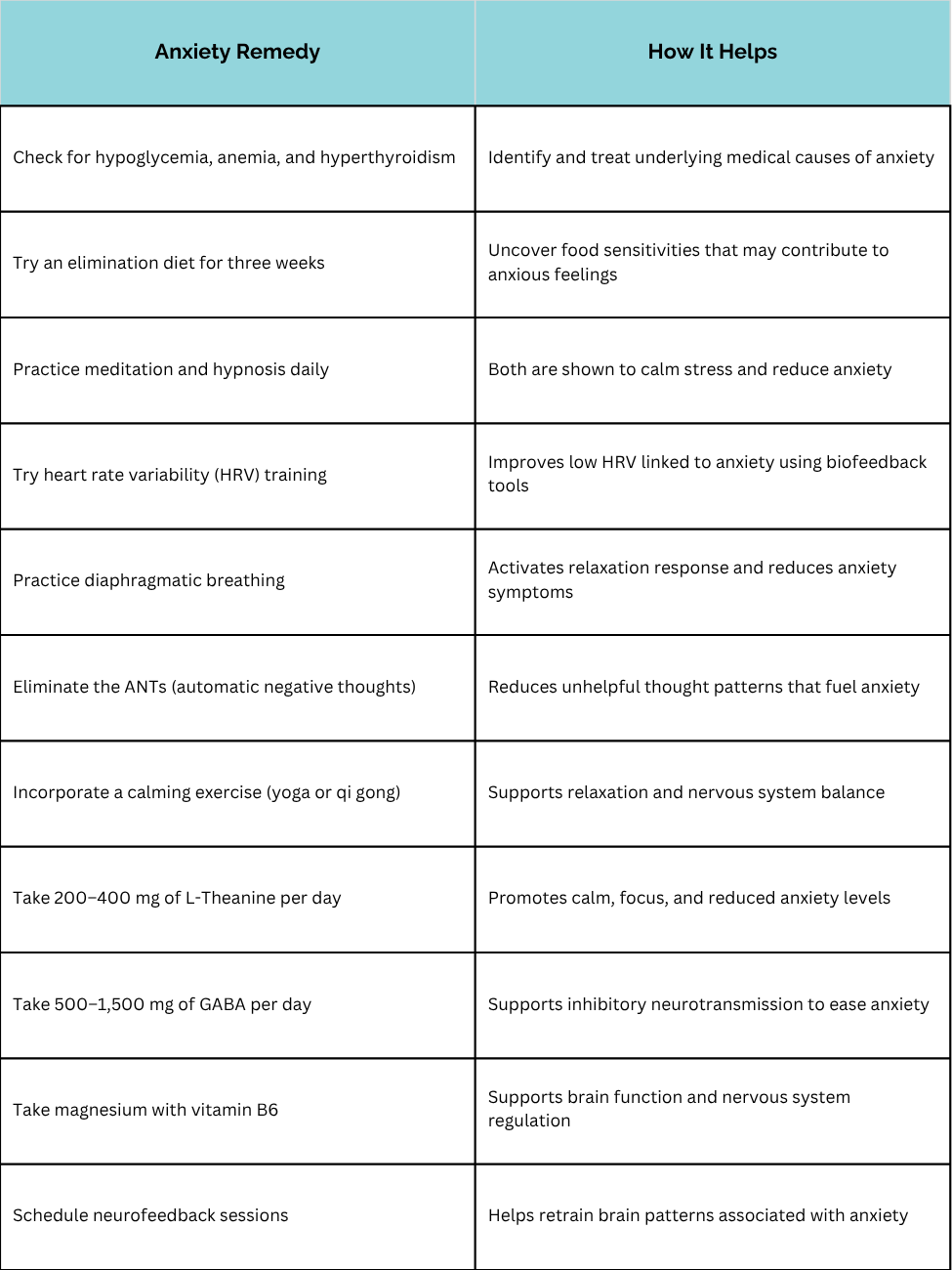
The good news is that there are natural remedies for anxiety that provide long-term benefits, and they don’t damage the brain. In this blog, you’ll learn more about the brain’s role in anxiety, as well as 11 natural anxiety treatments.
After the pandemic, prescriptions for antianxiety medications, such as benzodiazepines, dramatically increased. The problem is that they are addictive, and once you start them they are often very hard to stop.
Anxiety is not merely a fleeting feeling of nervousness. It’s a complex emotional state deeply rooted in the brain’s intricate networks. To effectively manage anxiety, it’s essential to comprehend how our brain contributes to these sensations.
Based on the brain SPECT imaging work at Amen Clinics, it’s clear that abnormal blood flow and activity levels in certain brain regions are associated with anxiety disorders. Here’s a brief overview of the main brain areas involved in anxiety and panic disorders.
The basal ganglia are large, deep brain structures that sit near the limbic system and play a crucial role in coordinating thoughts, emotions, and physical actions. They help regulate movement, especially when it comes to initiating and transitioning between actions smoothly.
Studies show that the basal ganglia are key players in habit formation. At Amen Clinics, brain imaging has revealed that these structures also help regulate the brain’s overall anxiety level.
When the basal ganglia are overactive, it’s commonly linked to symptoms such as chronic worry, muscle tension, hyperawareness, and fearfulness. In fact, one of the most statistically significant findings from the neuroimaging work is that individuals with heightened activity in the basal ganglia are more likely to engage in nail biting—a common, habit-driven response to anxiety.

At the core of our emotional responses lies the limbic system, a collection of structures including the amygdala, hippocampus, hypothalamus, and thalamus. This system is pivotal in processing emotions, forming memories, and orchestrating stress reactions.
Neurotransmitters are chemicals that transmit signals across nerve endings. Imbalances in certain neurotransmitters are linked to anxiety disorders:
Related: Try These 9 Natural Serotonin Boosters for Happier Moods and Less Worry
Prolonged stress can alter the brain’s structure and function—a concept known as neuroplasticity. Chronic anxiety may lead to:
By delving into the brain’s role in anxiety, we can adopt natural strategies that not only alleviate symptoms but also promote enduring mental well-being.
Press Play to Discover Foods That Help Calm Anxiety
In this video, Amen Clinics integrative nutritionist Cindy Santa Ana reveals foods that can soothe anxiousness while promoting healthy moods.
Click below to tune in:
Anxiety disorders are very painful, but too often people reach for marijuana, alcohol, or prescribed benzodiazepines. These can be of short-term benefit but cause long-term problems with addiction and memory issues.
If the above interventions are ineffective or only partly effective, you may want to consider other anxiety treatment options. Seek help from a mental health professional for a targeted treatment plan.
Anxiety disorders, panic attacks, and other mental health conditions can’t wait. At Amen Clinics, we provide personalized, science-backed treatment plans designed to target the root causes of your symptoms. Our 360-approach includes brain SPECT imaging, clinical evaluations, innovative therapeutic techniques, medications (when necessary), and holistic lifestyle recommendations to promote the health of your brain, body, and mind. Speak to a specialist today at 888-288-9834 or visit our contact page here.
Seger, Carol A, and Brian J Spiering. “A critical review of habit learning and the Basal Ganglia.” Frontiers in Systems Neuroscience vol. 5 66. 30 Aug. 2011, doi:10.3389/fnsys.2011.00066
Stathis, P et al. “Connections of the basal ganglia with the limbic system: implications for neuromodulation therapies of anxiety and affective disorders.” Acta Neurochirurgica. Supplement vol. 97,Pt 2 (2007): 575-86. doi:10.1007/978-3-211-33081-4_67
Cisneros T. Fills for Mental Health Prescription Drugs Rose During COVID and Remain High. GoodRx, February 21, 2023. https://www.goodrx.com/healthcare-access/research/fills-for-anxiety-and-depression-prescription-drugs-rose-during-covid-pandemic
Fortuna, Lisa R et al. “The Impact of COVID-19 on Anxiety Disorders in Youth: Coping with Stress, Worry, and Recovering from a Pandemic.” Child and Adolescent Psychiatric Clinics of North America vol. 32,3 (2023): 531-542. doi:10.1016/j.chc.2023.02.002