
Quiz: Do You Have Adult ADD/ADHD?
This post has been updated since its original publication date.
When you think of attention-deficit disorder (ADD), more commonly referred to as attention-deficit/hyperactivity disorder (ADHD), your mind probably goes straight to hyperactive schoolchildren. However, kids aren’t the only ones with this common condition. Adults can have it too.
A host of celebrities are sharing that they have been diagnosed with ADHD. For example, Olympic gold medalist Simone Biles announced on X that she has ADHD and has taken medication for the condition since she was a child. Maroon 5 frontman Adam Levine wrote in Additude Magazine that the ADHD he had as a child didn’t go away in adulthood. And “Dancing With the Stars” performer Karina Smirnoff told the Saturday Evening Post that she’s an adult with ADHD.
Unfortunately, too many adults with ADD/ADHD go undiagnosed and untreated. And this can have devastating lifelong consequences.
Too many adults with ADD/ADHD go undiagnosed and untreated. And this can have devastating lifelong consequences.
 Healthy SPECT Scan
ADD/ADHD SPECT Scan
In the ADD/ADHD SPECT scan here, the “holes” indicate areas of low blood flow and activity in the prefrontal cortex.
The PFC is responsible for planning, judgment, organization, follow-through, impulse control, empathy, and more. These are known as executive functions. When there is low activity in the PFC, people tend to have trouble with these functions.
Healthy SPECT Scan
ADD/ADHD SPECT Scan
In the ADD/ADHD SPECT scan here, the “holes” indicate areas of low blood flow and activity in the prefrontal cortex.
The PFC is responsible for planning, judgment, organization, follow-through, impulse control, empathy, and more. These are known as executive functions. When there is low activity in the PFC, people tend to have trouble with these functions.
WHAT IS ADULT ADHD?
ADD/ADHD is a disorder that affects brain development. It typically begins in childhood and can persist into adulthood. It is associated with a short attention span and behavior issues that can interfere with school, work, and relationships. It is estimated that 4.4% of American adults currently have ADD/ADHD, but experts suggest the condition is underreported in adults, so the number could be much higher. This indicates that many adults are likely unaware that they have the condition and remain untreated. Having undiagnosed ADHD or untreated ADHD can lead to consequences that lower your quality of life and can keep you from reaching your potential.ADULT ADD AND THE BRAIN
Individuals with ADD/ADHD are considered “neurodivergent.” Simply, this means their brains work differently than the brains of people who are “neurotypical.” A person who is neurotypical has healthy brain function. The brain-imaging work using SPECT scans at Amen Clinics shows that children and adults with ADD/ADHD typically have low activity in an area of the brain called the prefrontal cortex (PFC). In particular, activity in the PFC decreases when people with the condition try to concentrate. This is the opposite of what occurs in neurotypical individuals. In the healthy brain, concentration increases activity levels in the PFC.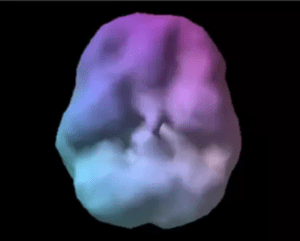 Healthy SPECT Scan
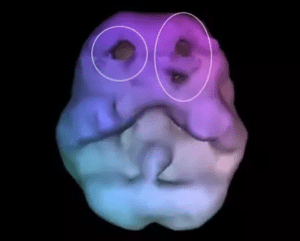 ADD/ADHD SPECT Scan
In the ADD/ADHD SPECT scan here, the “holes” indicate areas of low blood flow and activity in the prefrontal cortex.
The PFC is responsible for planning, judgment, organization, follow-through, impulse control, empathy, and more. These are known as executive functions. When there is low activity in the PFC, people tend to have trouble with these functions.
ADD/ADHD SPECT Scan
In the ADD/ADHD SPECT scan here, the “holes” indicate areas of low blood flow and activity in the prefrontal cortex.
The PFC is responsible for planning, judgment, organization, follow-through, impulse control, empathy, and more. These are known as executive functions. When there is low activity in the PFC, people tend to have trouble with these functions.
10 ADULT ADHD SYMPTOMS
Adults with ADD/ADHD may experience a wide range of emotional and behavioral symptoms, including the following. 1. Having a short attention span A lack of focus is one of the hallmark symptoms of ADD/ADHD. In adults, this can include having a hard time with routine tasks, not paying attention to details, making careless mistakes, and having trouble staying focused in conversations. If you have this brain-based disorder, you may start a lot of things but have difficulty completing them. Having a slew of unfinished projects lying around is a sign of adult ADD/ADHD. 2. Being disorganized Adults with ADD/ADHD often have trouble keeping things organized. At work, you might have a hard time finding what you need to finish a task because your desk is messy, your computer files are scattered randomly, and your emails are unorganized. This can make projects seem more challenging and take longer to complete. Disorganization also includes have trouble prioritizing assignments and keeping track of them. When you aren’t sure which task to tackle first, it can lead to procrastination. 3. Being easily distracted Having adult ADD/ADHD makes you more likely to notice more things in your environment compared to others. This means you can be easily distracted by external stimuli, including sounds, lights, scents, touch, or some tastes. For example, you may be overly aware of a tag in the back of your shirt, a flickering light, or a beeping noise. This acute sensitivity can prevent you from focusing on an important task at hand. 4. Having poor internal supervision Many people with ADD struggle with impulse control and judgment. You may say or do things reflexively without thinking about the consequences of your actions. This can lead to problems at work, at home, and in relationships. Another one of the common signs of adult ADHD is having a hard time learning from your mistakes. Making the same errors over and over is an indicator that you might have this condition. 5. Procrastinating and being chronically late Individuals with ADD/ADHD often have trouble with time management. You may put things off until the last minute. For example, you may wait until the night before a project is due to start working on it. ADHD adults are also notorious for being late for everything. Showing up 15 minutes, 30 minutes, or an hour late for work, appointments, and events is a red flag. 6. Being hyper focused Surprisingly, research shows that many adults with ADD/ADHD can achieve laser-like focus for certain things. In general, hyperfocus is more likely to occur when a person engages in something that they love to do or in things that are highly stimulating, frightening, fun, or novel. When hyperfocused, people become completely absorbed in an activity and tune out everything else. In these instances, you may not notice external stimuli, such as your spouse asking you a question, the doorbell ringing, or your dog barking because they need to go outside. 7. Being forgetful Forgetfulness is common in ADD/ADHD and can become a major issue on the job and in relationships. People with this condition often forget birthdays, anniversaries, and deadlines. You may leave your work materials at home or forget that it’s your day to pick up your child after school. In some cases, forgetfulness may be related to distractibility. If you aren’t paying attention to what someone is saying to you, it’s going to be harder to remember what they said. 8. Lacking motivation Some types of ADD/ADHD are associated with low levels of the neurotransmitter dopamine, which is heavily involved in motivation. Because of this, adults with this disorder may feel unmotivated. This can hold you back in your career and in other areas of your life. 9. Low self-esteem Self-doubt and a lack of confidence are common in people with ADD/ADHD. In part, this may come from growing up with people talking about you in a negative way due to your symptoms. Many ADHD types grow up hearing people say that they are “lazy,” “dumb,” or “troublemakers.” These hurtful comments can have lasting repercussions on a person’s self-image. 10. Misusing substances Adults with ADD/ADHD are at a greater risk for substance use disorders compared with people who don’t have the condition, according to research. If you turn to alcohol, marijuana, nicotine, or other substances to self-medicate or to improve focus, it’s a problem.SEEKING AN ADULT ADHD DIAGNOSIS
Adults who suspect they may have the condition often wait to seek help. At Amen Clinics, which has helped tens of thousands of mental health patients over the past 30-plus years, adults typically don’t get diagnosed with ADD until they are experiencing the following:- Concerns about a child with ADD/ADHD: Most adult patients at Amen Clinics are only diagnosed with ADHD after they bring in one of their children for an evaluation. During a thorough history, the child psychiatrists at Amen Clinics always ask about family history. Through these questions, many parents discover that they have the same symptoms of ADD/ADHD as their children.
- Poor work performance: Adults may wait to seek an evaluation until they’re having problems at work. They may be passed over for promotions, demoted, or at risk of getting fired.
- Emotional, cognitive, or behavioral issues: Many people seek help only after they have been suffering from problems, such as moodiness, chronic anxiety, restlessness, addictions, uncontrolled anger, marital problems, financial problems, or impulse control problems.