

Mental health and substance abuse rarely exist in separate lanes. For many people, they are closely intertwined, varying in severity and outcomes that may unfold quietly or chaotically, and are often misunderstood.
If you seek help for anxiety, depression, or burnout, you may find that alcohol or drug use plays a role in exacerbating or even creating these struggles. Others may enter treatment for substance abuse and later realize an underlying mental health condition has been driving the behavior all along.
Research consistently shows that mental health and substance abuse frequently co-occur, creating a complex cycle that can be difficult to break without the right support. Substances may offer temporary relief from emotional pain, racing thoughts, or trauma-related stress; however, over time, they almost always worsen symptoms, disrupt brain function, and make recovery more challenging in both the short and long term.
Understanding this connection matters. When mental health and substance use are addressed together, rather than in isolation, outcomes can improve dramatically. By focusing on how the brain functions instead of behaviors or labels, treatment becomes more compassionate, precise, and effective.
Medically reviewed by Kandace Licciardi, MD, Medical Director, Amen Clinics
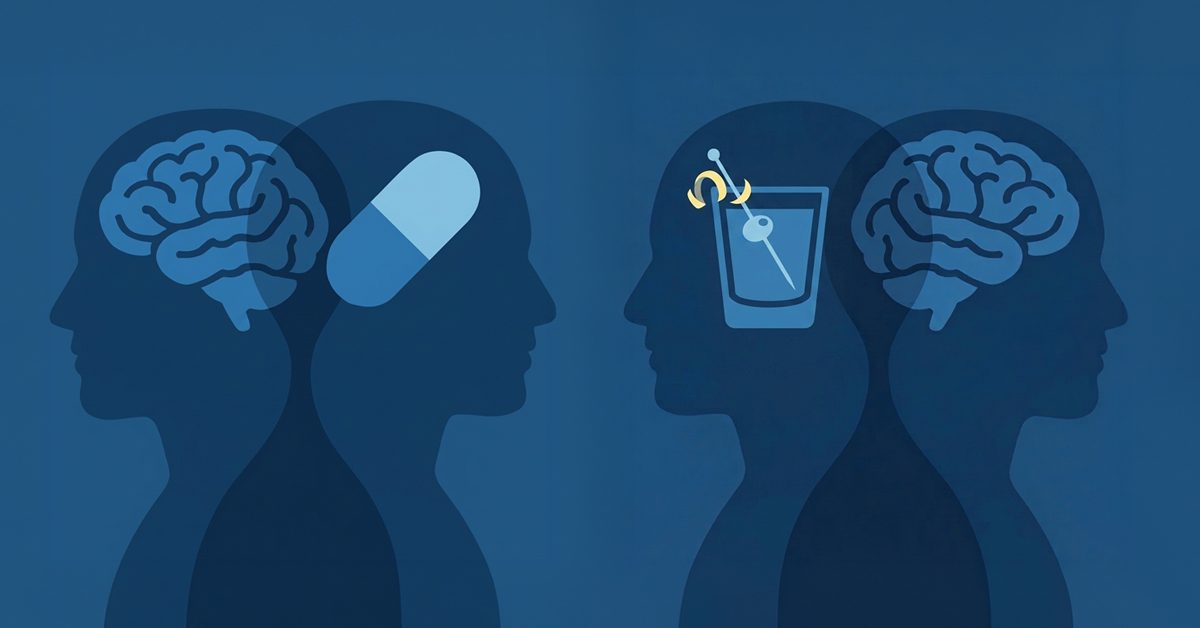
While substances may temporarily alter how someone feels, they also change brain chemistry over time. These changes worsen underlying mental health conditions and can even trigger new ones.
Mental health conditions and substance use disorders influence each other in powerful ways. Brain chemistry, emotional regulation, stress response systems, and impulse control are often involved in both. When one issue goes untreated, it intensifies the other, which creates a loop that feels impossible to escape without help.
Rather than viewing substance abuse as a moral failing or mental illness as a character flaw, modern neuroscience encourages a more understanding viewpoint: these are brain-based challenges that deserve thoughtful, individualized care.
Related: Polydrug Use Disorder Harmful Impacts on Brain and Mental Health
A 2025 systematic review highlights how mental health and substance abuse often co-occur because both affect the same brain systems. Particularly, they directly involve regions controlling reward, motivation, mood regulation, and stress response.
Many people use substances in an attempt to manage symptoms such as persistent sadness, anxiety, intrusive thoughts, emotional numbness, or restlessness. While substances may temporarily alter how someone feels, they also change brain chemistry over time. These changes worsen underlying mental health conditions and can even trigger new ones.
According to epidemiological research, nearly half of those with a substance use disorder (SUD) also meet criteria for at least one mental health condition. This interaction is known as co-occurring disorders, or dual diagnosis, a term used when someone experiences both a mental health disorder and a SUD simultaneously.
Essentially, this overlap is not accidental. A 2018 study shows that shared genetic vulnerabilities, early life stress, trauma exposure, and chronic stress all increase risk for both mental health challenges and substance misuse.
For many people, substance use begins as an attempt to cope. An individual may not be looking to escape responsibility, but they feel desperate to “turn off” emotional pain.
People living with untreated anxiety, depression, ADHD, trauma, or chronic stress may turn to alcohol, cannabis, stimulants, or other substances to quiet racing thoughts, numb emotional distress, or boost focus and energy. Initially, the relief can feel incredible as your brain’s reward system responds, which reinforces the addictive behavior.
Over time, however, tolerance develops. More of the substance is needed to achieve the same effect, while the brain’s natural ability to regulate mood and stress weakens. Research shows that symptoms often return stronger than before, leading to increased use, deeper dependence, and greater emotional distress.
The addictive cycle is not a personal failure. It is an entirely predictable neurobiological response.
Substance abuse significantly alters brain function, both in the short and long term. Research shows how many substances affect blood flow, neurotransmitter balance, impulse control, and emotional regulation. These changes intensify symptoms such as irritability, anxiety, low motivation, poor concentration, or mood instability.
Repeated substance use can disrupt the prefrontal cortex (the area responsible for judgment, self-control, and decision-making), research shows. At the same time, reward circuits become hypersensitive, making cravings stronger and stress harder to manage.
Amen Clinics’ work with brain SPECT imaging has helped illustrate how addiction may be associated with patterns of overactivity or underactivity in specific brain regions. While SPECT is not used as a standalone diagnostic tool, understanding functional brain patterns (along with thorough personal histories and detailed clinical assessments) helps our clinicians tailor treatment strategies more effectively to an individual’s unique needs. The focus is on supporting individualized care rather than one-size-fits-all solutions.
Substances may temporarily elevate mood by increasing dopamine or serotonin activity. Over time, however, research has shown that they often worsen depressive symptoms, disrupt sleep, and reduce the brain’s natural ability to experience pleasure.
Alcohol and drugs may briefly reduce anxiety, but they increase baseline anxiety levels over time by dysregulating stress hormones and neurotransmitters.
Those with trauma histories may use substances to cope with intrusive memories, hyperarousal, or emotional numbness. Unfortunately, recent studies show that substance use can interfere with trauma processing and prolong symptoms.
People with ADHD may self-medicate to temporarily ease challenges with focus, impulsivity, or restlessness. According to a narrative review study in Cureus, higher rates of SUD are strongly linked to individuals with untreated ADHD.
Substance use can destabilize mood cycles, which further intensifies manic or depressive episodes in those with bipolar disorder and complicates both diagnosis and treatment.
It’s not always obvious when someone is dealing with co-occurring challenges. Before warning signs become overwhelming, they often subtly appear in daily habits, relationships, and emotional coping patterns. The most common indicators include:
If several of these signs are present (especially across emotional, behavioral, and relational areas), a professional evaluation can offer clarity, reduce stigma, and open the door to effective, integrated treatment.
Related: What’s Missing in a 12-Step Program for Addiction Treatment?
A brain-first perspective starts with a simple but powerful idea: your behavior is rooted in how well your brain functions. Instead of asking, “What’s wrong with you?” the question becomes, “What’s happening in your brain?”
Amen Clinics utilizes neuroscience, psychiatric evaluation, and lifestyle factors to understand mental health challenges at their biological roots. This brain-first approach recognizes that two people with similar symptoms may have very different brain patterns and may require different treatment strategies.
If you or someone you love is navigating both mental health challenges and substance use, it’s important to know the different ways that mental health and substance abuse treatment can be addressed together.
Personalized treatment plans help reduce relapse risk, improve emotional regulation, and support long-term recovery. In a lot of cases, effective care can include:
Keep in mind that common therapy modalities — such as cognitive behavioral therapy (CBT), dialectical behavior therapy (DBT), eye movement desensitization reprocessing (EMDR), and acceptance and commitment therapy (ACT) — target different aspects of cognition, emotion, and behavior. That’s why it’s so important to talk to a qualified mental health professional about what could work best for you.
The goal of brain-based care is to consider the full picture: biology, psychology, environment, and behavior. By identifying brain patterns related to addiction, mood disorders, and trauma, clinicians can tailor interventions that address how your brain actually works to help or hinder you. This approach reduces relapse risk, improves emotional stability, and supports sustainable recovery, especially when paired with ongoing lifestyle changes.
Supporting someone with co-occurring mental health and substance abuse challenges requires patience, education, and compassion. Here are a few helpful steps you can take today:
Remember: caregivers deserve support, too. There’s group support available for family members of individuals with mental illness available through the National Alliance for Mental Illness (NAMI). Also, there are 12-step support groups for family and friends of alcoholics and addicts such as Al-Anon. You don’t have to do this alone.
Mental health conditions and substance abuse share overlapping brain systems involved in mood, stress, and reward, making them biologically interconnected.
Yes. Substance use can trigger or worsen mental health conditions by altering brain chemistry and stress regulation.
A dual diagnosis refers to having both a mental health disorder and a substance use disorder at the same time.
Integrated treatment that addresses both conditions simultaneously is associated with better outcomes.
Yes. Research shows the brain has remarkable capacity for recovery, especially with sustained treatment and lifestyle support.
Mental health and substance abuse often intersect, but they do not define a person’s future. With individualized care that addresses brain function and emotional well-being, recovery is possible and sustainable.
If symptoms are interfering with your daily life, reaching out for support can be the beginning of meaningful change.
About the Reviewer
Kandace Licciardi, MD, Medical Director, Amen Clinics
Dr. Kandace Licciardi is a double board-certified psychiatrist in adult and forensic psychiatry and serves as Medical Director of Amen Clinics. She takes a comprehensive, whole-person approach to care, integrating evidence-based psychiatric treatment with lifestyle, social, and wellness factors. Dr. Licciardi has extensive experience treating depression, anxiety, bipolar disorder, psychotic disorders, and borderline personality disorder, with special expertise in early psychosis intervention. She completed her psychiatry residency at Maimonides Medical Center and her forensic psychiatry fellowship at New York University.
National Institute on Drug Abuse. (2024). Co-occurring disorders and health conditions. National Institutes of Health. Retrieved January 9, 2026, from https://nida.nih.gov/research-topics/co-occurring-disorders-health-conditions
Tesselaar, D. R. M., Schellekens, A. F. A., Homberg, J. R., Booij, J., & Guerrin, C. (2025). Psychiatric comorbidity in substance use disorders: A systematic review of neuro-imaging findings. Neuroscience & Biobehavioral Reviews, 177, 106325. https://doi.org/10.1016/j.neubiorev.2025.106325
Common Comorbidities with Substance Use Disorders Research Report. Bethesda (MD): National Institutes on Drug Abuse (US); 2020 Apr. Available from: https://www.ncbi.nlm.nih.gov/books/NBK571451/
Lee, R. S., Oswald, L. M., & Wand, G. S. (2018). Early Life Stress as a Predictor of Co-Occurring Alcohol Use Disorder and Post-Traumatic Stress Disorder. Alcohol research : current reviews, 39(2), 147–159. https://pmc.ncbi.nlm.nih.gov/articles/PMC6561395/
Jordan, C. J., & Andersen, S. L. (2017). Sensitive periods of substance abuse: Early risk for the transition to dependence. Developmental Cognitive Neuroscience, 25, 29–44. https://doi.org/10.1016/j.dcn.2016.10.004
Stellern, J., Xiao, K. B., Grennell, E., Sanches, M., Gowin, J. L., & Sloan, M. E. (2023). Emotion regulation in substance use disorders: a systematic review and meta-analysis. Addiction (Abingdon, England), 118(1), 30–47. https://doi.org/10.1111/add.16001
Elsevier. (n.d.). Addiction. In ScienceDirect Topics: Neuroscience. https://www.sciencedirect.com/topics/neuroscience/addiction
Belujon, P., & Grace, A. A. (2017). Dopamine System Dysregulation in Major Depressive Disorders. The international journal of neuropsychopharmacology, 20(12), 1036–1046. https://doi.org/10.1093/ijnp/pyx056
Hinckley, J. D., Adams, Z. W., Dellucci, T. V., & Berkowitz, S. (2024). Co-occurring trauma- and stressor-related and substance-related disorders in youth: A narrative review. Medical research archives, 12(8), 10.18103/mra.v12i8.5688. https://doi.org/10.18103/mra.v12i8.5688
Srichawla, B. S., Telles, C. C., Schweitzer, M., & Darwish, B. (2022). Attention Deficit Hyperactivity Disorder and Substance Use Disorder: A Narrative Review. Cureus, 14(4), e24068. https://doi.org/10.7759/cureus.24068
Spencer, A. E., Valentine, S. E., Sikov, J., Yule, A. M., Hsu, H., Hallett, E., Xuan, Z., Silverstein, M., & Fortuna, L. (2021). Principles of Care for Young Adults With Co-Occurring Psychiatric and Substance Use Disorders. Pediatrics, 147(Suppl 2), 229–239. https://doi.org/10.1542/peds.2020-023523F
Juliano, V. A. L., Albernaz-Mariano, K. A., Covre, L. H. H., Jucá, P. M., Pereira, R. M., Shigeo-de-Almeida, A., Sampaio, L. L., Duque, E. A., & Munhoz, C. D. (2025). Neurobiological intersections of stress and substance use disorders. Frontiers in neuroscience, 19, 1548372. https://doi.org/10.3389/fnins.2025.1548372
Oliva, H. N. P., Prudente, T. P., Naveda, A. M. P., Monteiro-Junior, R. S., Potenza, M. N., Morgan, P. T., & Angarita, G. A. (2026). Sleep alterations in substance use disorders: A systematic review and meta-analysis. eClinicalMedicine, 91, 103723. https://doi.org/10.1016/j.eclinm.2025.103723
Volkow, N.D. and Blanco, C. (2023), Substance use disorders: a comprehensive update of classification, epidemiology, neurobiology, clinical aspects, treatment and prevention. World Psychiatry, 22: 203-229. https://doi.org/10.1002/wps.21073
Liu, S., Zhang, T., Yang, Y. et al. A study on the effects of addiction level, stress, and social support of drug relapse patients on changes in motivation of quitting substance misuse behaviors. BMC Psychol 13, 612 (2025). https://doi.org/10.1186/s40359-025-02917-4