
You’ve prayed about it. Not once, but hundreds of times. You’ve fasted, journaled, memorized Scripture, gone forward at the altar, and begged God to lift the heaviness. And still, you wake up with the same weight on your chest.
So you start to wonder the question you’d never say out loud: What’s wrong with my faith?
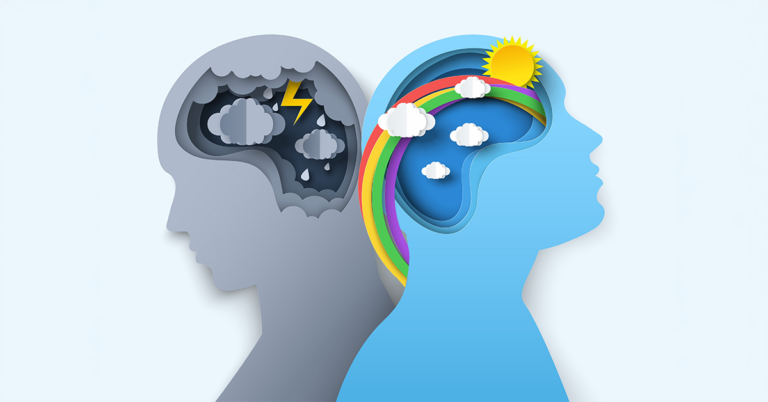
If that’s where you are, please receive this first: your struggle is not a spiritual failure. The persistent anxiety, the depression that won’t lift, the fog and fatigue and dread—these are not evidence that you don’t love God enough or believe hard enough. Very often, they are evidence that something in your brain needs care, too.
This isn’t a challenge to your faith. It’s an invitation to a fuller understanding of how God made you—and to the healing that becomes possible when we stop treating the soul and the brain as if they were separate things.

Let’s name what’s really happening, because it hurts.
In many faith communities, mental health struggles get treated as purely spiritual problems—a sign of weak faith, unconfessed sin, or a failure to trust God. Researchers have a term for it: the spiritualisation of mental illness. And the consequences are real. That same research warns that encouraging people with mental health concerns to pursue exclusively spiritual interventions—more prayer, more faith—can actually prolong their distress when effective help isn’t sought in a timely way.
Other studies describe how religiously reinforced stigma can lead congregations to frame depression as a lack of faith, pressuring believers toward spiritual solutions instead of, rather than alongside, real care.
The result is a devastating double burden. Faithful people don’t just suffer—they suffer and feel ashamed for suffering. They hide it. They perform wellness on Sunday and fall apart on Monday. And the very community that should be their refuge becomes a place where they can’t tell the truth.
That has to change. And understanding the brain is how it starts.
Let’s be crystal clear, because this matters: prayer is not the problem. Faith is not the problem.
The research is actually overwhelming on this point. In a landmark review spanning more than a century of studies, Duke University’s Dr. Harold Koenig found that religious and spiritual involvement is broadly associated with better mental health—less depression, lower anxiety, greater well-being, and more hope and optimism. A 2025 systematic review similarly found that heartfelt prayer is associated with greater well-being and lower anxiety and depression.
So prayer works. Faith heals. Community protects.
The problem is never prayer. The problem is the belief that prayer is the only tool God gave us—and that reaching for anything else is a failure of trust.
Here’s the truth that sets so many believers free.
You are not just a soul in a body. You are an embodied person, and the organ through which you experience everything—your thoughts, your emotions, your worship, your ability to hope—is your brain. When that organ isn’t functioning well, your spiritual life feels it.
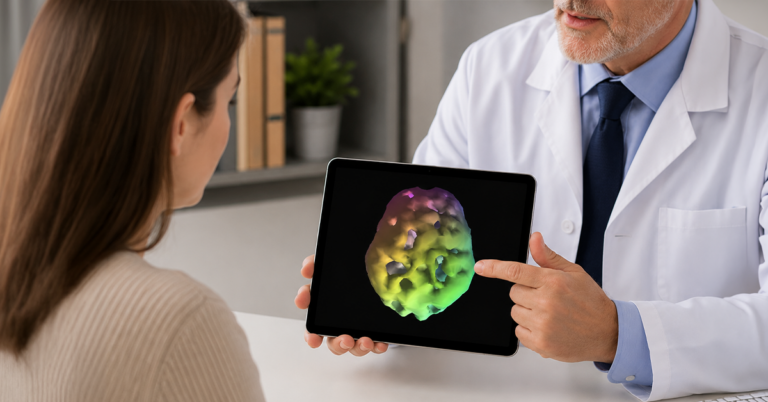
Modern science affirms this. The National Institute of Mental Health describes mental illnesses as involving disruptions in the brain’s circuits. And through decades of brain SPECT imaging at Amen Clinics—now nearly 300,000 scans—Dr. Daniel Amen has demonstrated the same principle again and again: mental health is brain health.
Consider what this means in practice:
Read those again slowly. None of that is a sin issue. A struggling brain is not a rebellious heart.
Here’s a question that reframes everything.
If a faithful believer had diabetes, would you tell them to pray harder instead of managing their blood sugar? If they broke their leg, would you say the cast reveals weak faith? Of course not. We’d pray and we’d get them care. We’d see no contradiction at all.
Yet somehow, when the organ in question is the brain—the most complex organ in the body—we’ve been taught to treat it as a spiritual referendum instead of a medical reality.
The brain is an organ. It can be injured, depleted, inflamed, and dysregulated. And like any organ, it can be healed. Seeking help for it is no more a betrayal of faith than taking insulin or setting a bone.
Now for the good news—and it’s genuinely thrilling.
Your brain can change. Thanks to neuroplasticity, it can rewire, heal, and grow throughout your entire life. It’s the truth Dr. Amen has built his life’s work on: you are not stuck with the brain you have.
And here’s what should stop you in your tracks: Scripture said it first. “Be transformed by the renewing of your mind” (Romans 12:2). What neuroscientists call plasticity, Paul called renewal. Two thousand years before the first brain scan, Scripture pointed to the very capacity science has now confirmed.
Faith and brain science aren’t at war. They’re describing the same God-given design from two different angles.
So what does real healing look like? It looks like refusing the false choice between prayer and care—and tending the whole person God made.
Notice that faith isn’t removed from this picture. It’s completed by it. The whole-person approach used at Amen Clinics—the Amen Clinics Method—has always included the spiritual circle alongside the biological, psychological, and social. Because you were never four separate people. You were always one.
And if you are struggling right now, please hear this: reaching out to a qualified professional is an act of wisdom and courage, not a failure of belief. God works through doctors and counselors just as surely as He works through prayer.
If your heart aches for a way to care for your soul and your brain—without choosing between them—that’s exactly what the Amen WHOLE-4 was built for.
Created by Dr. Daniel Amen and offered through Amen University, WHOLE-4 weaves together brain science and Scripture into one transformative journey, designed for churches, counseling centers, and faith communities.
Across its sessions, participants learn to restore energy and vitality, renew their thinking, rebuild life-giving relationships, and deepen their walk with God—so that healing reaches every part of who they are.
It’s grounded in more than four decades of clinical practice and the timeless truth of Scripture, and it’s built to be walked through together, in community, where shame loses its power.
You can explore the vision behind it in Where Brain Science Meets Scripture: Inside Amen WHOLE-4 and Find a New Path to Whole-Person Healing with Amen WHOLE-4.
You don’t have to choose between your faith and your healing. You never did. Discover the Amen WHOLE-4 and bring whole-person hope to your community today.