

TL;DR
Many adults live with untreated ADHD without realizing it, often mistaking symptoms like disorganization, lateness, and relationship struggles for personality flaws. One man’s story shows how a symptom-only approach didn’t work, but a brain-based evaluation with SPECT imaging revealed the underlying issue. With a personalized, whole-body treatment plan, he was able to better understand his brain, reduce self-blame, and make meaningful, lasting changes in his life.
Medically reviewed by Steven Storage, MD, Amen Clinics.

For years, John Miranda struggled with things that seemed simple to everyone else. He was often late. Staying organized felt like an uphill battle. Even being fully present in conversations with loved ones could be difficult.
Like many adults with undiagnosed ADHD, John began to wonder if something deeper was going on. While watching a PBS special hosted by Dr. Daniel Amen, John recognized himself in the ADHD symptoms being discussed. “I was like, ‘Oh my gosh, he’s describing me,’” he recalls.
John’s experience is far from uncommon. Experts estimate that about 6 percent of U.S. adults, roughly 15.5 million people, have attention deficit hyperactivity disorder (ADHD), also known as attention deficit disorder (ADD), and nearly half are diagnosed in adulthood. In one national survey, 25 percent of adults said they suspected they may be struggling with undiagnosed ADHD.
Yet recognition is only the first step. For many, including John, understanding what’s going on doesn’t immediately lead to answers or relief. His path to getting the right help was anything but straightforward.
The initial diagnostic process and treatment plan from his primary care provider didn’t sit right with him, so he decided to forego their recommendation. And he continued to have trouble at work and in his relationship for the next decade.
What ultimately changed things was not just a diagnosis, but a new way of understanding ADHD as a brain health issue.
Here is John’s story. You’ll learn how gaining insight into his brain helped him move from frustration, underachievement at work, and relationship issues to clarity, confidence, and real, lasting change.
While watching a PBS special hosted by Dr. Daniel Amen, John Miranda recognized himself in the ADHD symptoms being discussed. “I was like, ‘Oh my gosh, he’s describing me,’” he recalls.
Related: 10 Signs You May Have Adult ADD
After recognizing himself in the symptoms of ADHD, John decided to take the next step and seek help. Like many adults, he turned to a traditional healthcare provider, hoping for clarity and direction.
What he experienced instead was a familiar path for many people struggling with attention and focus issues. The evaluation focused primarily on symptoms. He was given a basic diagnostic exam and quickly offered medication as the primary solution.
“They basically gave me a computer test and wanted to offer some stimulants,” John recounts. He thought, “If that’s the only thing that can help me, I didn’t feel comfortable doing that.”
Without a deeper understanding of what was happening in his brain, John didn’t yet know that there were other options available to him. And like many people in similar situations, John stepped away from the process altogether.
Over time, the challenges continued. As a teacher, he noticed it was taking him much longer than others to complete everyday tasks like grading papers. Staying organized felt nearly impossible, and small responsibilities began to pile up.
“It was taking me longer to do my work… my lack of organization, not picking up things,” he says. “It’s one of those things where it’s like I’m not purposely doing it.”
Without answers, it was easy to internalize these challenges as personal shortcomings rather than signs of something in his brain. “It was just kind of my personality trait at this point,” John explains.
But the impact didn’t stop at work. Over time, these patterns began to affect his relationship as well. As frustration grew, he and his wife turned to marriage counseling, searching for solutions without yet realizing the root cause.
John’s turning point didn’t come from a diagnosis. It came from a shift in perspective.
While in marriage counseling, his counselor mentioned Dr. Amen’s book, Change Your Brain, Change Your Life. That was the same name of the public television special that John had seen a decade before.
“I was like, ‘Oh wait, I remember I watched that PBS show 10 years ago,’” John says. “I was so fascinated by everything that I was listening to.”
This time, the ideas landed differently. Instead of seeing his difficulties as personality flaws or relationship problems, John began to understand them through a new lens, one rooted in brain function.
One example stood out to him in a powerful way. He learned about couples who found themselves in repeated conflict, not because of the relationship itself, but because of untreated ADHD.
“One couple wanted to fight so that they could get an adrenaline rush,” John recalls. “I thought that was so interesting… you’re purposely picking a fight so that you can get your chemicals released that you need to function.”
Many people with ADHD have low activity in the front part of their brains, due to lower levels of the neurotransmitter dopamine. As a way to feel more alert, they are often conflict or excitement seeking. They can be masterful at making other people mad or angry at them.
That insight helped him connect the dots in his own life. Behavior that once seemed confusing or frustrating began to make more sense when viewed through the lens of brain chemistry and regulation.
“I just thought it was so interesting and profound how behavior was impacted… by vitamins or by medication,” he says.
For the first time, John began to grasp a few key concepts: ADHD is not simply about willpower, habits, or personality. It is deeply connected to how the brain functions. And without addressing the brain directly, real and lasting change can be difficult to achieve.
That realization led him to an important decision.
“At some point I was like, ‘I think I just need to get a scan and get a doctor to tell me what it is that I’ve got,’” John says.
It marked a major shift, one that would begin to move him from confusion and frustration toward clarity and targeted support.
Related: Not Just ADHD: How to Spot the Signs of Complex ADHD
When John finally decided to move forward, he booked an appointment at Amen Clinics in Costa Mesa, California. Immediately, what stood out to him was how different the approach felt.
“I was pretty close using all of the tools,” he says. “But now the actual treatment implementation… that’s what shifted.” Instead of a one-size-fits-all solution, he was introduced to a more nuanced understanding of ADHD.
“It wasn’t like, ‘Oh, you have ADHD, take this stimulant,’” John explains. “It was like, ‘Whoa, wait a minute. This stimulant is going to increase your anxiety. It’s like putting gas on a fire.’”
That insight helped explain why traditional treatment hadn’t felt right for him. This reinforced what he had already experienced. Treatment needs to go beyond symptoms.
For John, this was a key moment. His challenges were not random or personal failures. They were connected to how his brain was working.
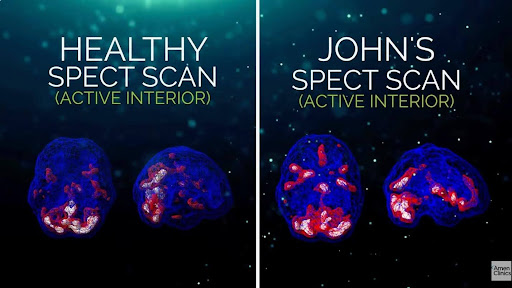
A key part of this deeper understanding comes from brain SPECT imaging. This specialized scan measures blood flow and activity patterns across different regions of the brain, providing insights that cannot be seen through symptom checklists alone.
Rather than guessing based on behavior, SPECT imaging allows clinicians to observe how specific areas of the brain are functioning. This can reveal patterns related to focus, mood regulation, impulse control, and anxiety.
In addition, at Amen Clinics, our brain-imaging research has identified seven distinct types of ADD, each with its own pattern of brain activity. This helps explain why treatment that works for one person may not work for another. It’s why stimulant medication, while helpful for some people with ADHD, can worsen symptoms in others.
For someone like John, this kind of insight can be life-changing. “Having awareness, looking at the scan, seeing the symptoms… it’s no longer like I’m a bad husband, or a bad person,” he says.
Instead, the focus shifts from blame to understanding, and from frustration to targeted solutions.
ADHD is often misunderstood as simply a problem with attention or hyperactivity, but it is more complex than that.
At its core, ADHD can involve challenges with:
For many adults, these symptoms show up in everyday life as chronic lateness, difficulty completing tasks, forgetfulness, or relationship strain, just as John experienced.
Without proper understanding, these behaviors are often misinterpreted as laziness, lack of effort, or personality flaws. In reality, they are frequently rooted in underlying brain dysfunction.
One of the biggest shifts for John was realizing that effective treatment needed to address more than just one symptom.
“It’s multifaceted,” he says. Rather than focusing on a single intervention, he was given support and strategies tailored to how his brain works. This included setting reminders and developing structured routines, as well as targeted interventions designed to improve function over time.
“It gives me the tools to help be successful,” John explains. He describes the experience with a powerful analogy: “It’s like someone that’s not wearing their glasses… it’s not that they’re being defiant, they just can’t see.”
With the right solutions, things that once felt overwhelming became manageable.
At Amen Clinics, ADHD is approached as a brain health issue. For John and others with mental health issues, the process begins with a comprehensive evaluation that includes brain SPECT imaging, a detailed personal history, and clinical assessments. This allows clinicians to understand not just the symptoms, but the underlying brain patterns driving them.
Using this information, clinicians apply precision medicine to develop a targeted treatment plan. With holistic psychiatry, we combine cutting-edge neuroscience with natural ways to treat mental health conditions and neurodevelopmental disorders.
Rather than relying solely on medication, ADHD treatment plans may include:
This whole-body approach helps ensure that treatment addresses the full picture, not just isolated symptoms.
For John, this approach made all the difference, not only for him, but for his relationships as well. Now that he’s gained the skills to help manage his ADHD, he wants to spread the word about this advanced approach. “I would love to share that to help other people,” he says.
Here are some of the most common ADHD symptoms in adults:
Yes, ADHD often looks different in adults. While children may show more hyperactivity and impulsivity, adults are more likely to experience challenges with focus, organization, time management, and emotional regulation.
Many adults go undiagnosed for years, often assuming their struggles are character flaws rather than signs of a treatable brain health condition.
No, medication is not the only option for treating ADHD. While stimulant medications like Adderall or Ritalin can be helpful for some people, they are not effective for everyone and may worsen symptoms in certain cases.
A more comprehensive, whole-body approach is more beneficial. Recommendations may include nutrition, supplements, lifestyle changes, therapy, and targeted interventions based on your unique brain patterns.
Amen Clinics treats ADHD using an individualized, brain-based approach rather than a one-size-fits-all model.
The process begins with a comprehensive evaluation that includes brain SPECT imaging, a detailed personal history, and neuropsychological testing to understand how your brain is functioning. It also looks at how biological, psychological, social, and spiritual factors may be contributing to your issues.
Based on this information, clinicians use precision medicine to create a tailored treatment plan. This may include targeted nutrition, supplements, lifestyle strategies, therapy, and, when appropriate, carefully selected medication. The goal is to address the root causes of symptoms and support optimal brain health, not just manage behaviors.
ADHD, ADD, and other mental health conditions can’t wait. At Amen Clinics, we practice precision medicine—using brain SPECT imaging and comprehensive evaluations to understand what’s really happening in your brain, not just your symptoms.
Our whole-body approach to holistic psychiatry combines cutting-edge neuroscience with natural ways to treat mental health conditions, including targeted nutrition, supplements, lifestyle strategies, therapy, and medications (when necessary). Every treatment plan is personalized to address the root causes of your struggles and support the health of your brain, body, and mind.
Don’t settle for guesswork. You deserve answers, and a plan built specifically for you. Speak with a Brain Health Advisor today at 888-288-9834 or visit our contact page to get started.
Centers for Disease Control and Prevention Website “Attention-Deficit/Hyperactivity Disorder Diagnosis, Treatment, and Telehealth Use in Adults — National Center for Health Statistics Rapid Surveys System,” United States, October–November 2023, Morbidity and Mortality Weekly / October 10, 2024 / 73(40);890–895. https://www.cdc.gov/mmwr/volumes/73/wr/mm7340a1.htm
The Ohio State University, Wexner Medical Center website
October 14, 2024
Accessed April 8, 2026