
TL;DR:
There’s a reason you feel different after scrolling. Your digital life isn’t just entertainment, it’s influencing how your brain manages mood, attention, and stress.
Social media platforms have quietly become one of today’s biggest mental health disruptors, affecting teens and adults alike. Its impact is evident in self-esteem dips, rising anxiety, and worsening depression.
Through our work with tens of thousands of patients at Amen Clinics, we’ve seen firsthand how digital habits can either support your mental wellness or slowly erode it.
Medically reviewed by Kandace Licciardi, MD, Medical Director, Amen Clinics
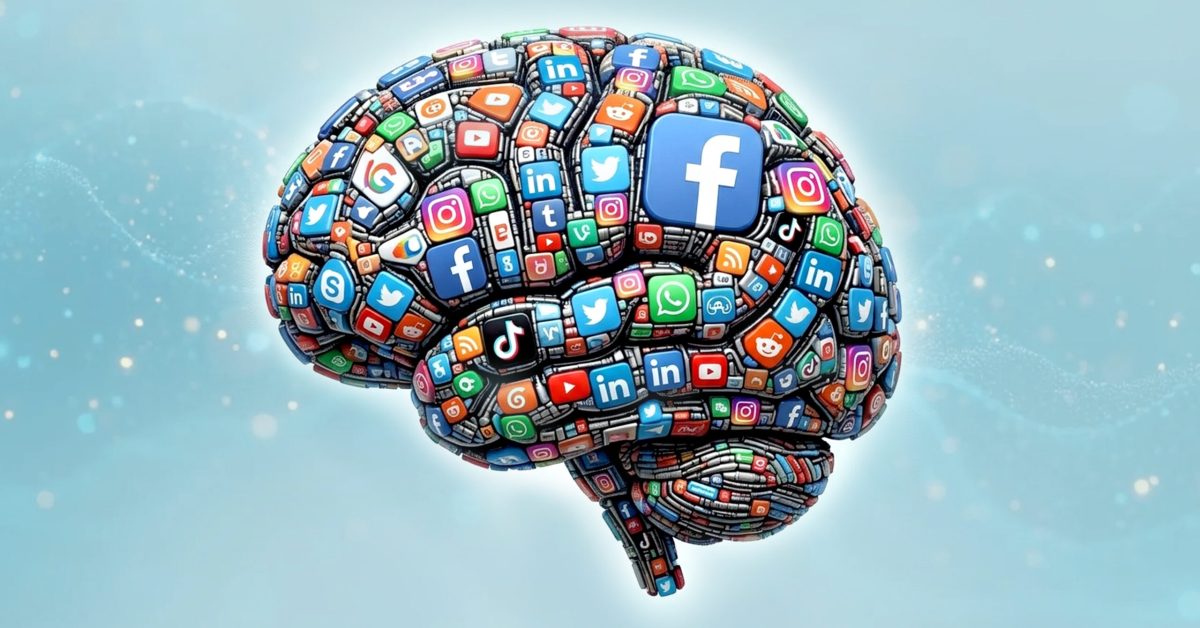
In this blog, we’re pulling back the curtain on how your online interactions have been shaping your mind without your permission.
First, we’ll expose the hidden ways social media can manipulate your mood and hijack your focus. Then, we’ll share practical strategies to help you build a healthier, more empowering relationship with the digital world.
In short, you’ll discover how social media affects your mental health — and what you can do right now to protect your brain and well-being.
Learning how social media affects mental health equips you to recognize the patterns that impact your emotional and cognitive well-being.
Let’s take a closer look at what happens to the brain when you scroll through social media.
One of the surprising harms of social media is that it can actually make you feel lonelier.
As humans, we’re hardwired to connect socially. It’s how we survived for millions of years, by sticking together, avoiding danger, pooling resources, and forming strong bonds.
Dopamine is your brain’s feel-good hormone and a critical component of its reward circuitry. When your brain releases dopamine in response to something life affirming, such as connecting socially, the good feelings motivate you to repeat actions that ensure your survival.
When connecting socially online, every comment, like, or share on your posts triggers a small release of dopamine. However, when you return again and again, it can cause a not-so-healthy dopamine loop.
That’s when you compulsively check your social media apps in response to notifications or you stay on for the next exciting video for too long, all to get more of the feel-good neurochemical dopamine.
But the more you do it, the more dopamine hits you need to reach the same level of feeling good. While terrible for your brain and mental health, the dopamine loop serves the social media apps by keeping you engaged and online.
Eventually, your brain gets overstimulated by the constant exposure to images, videos, and updates. But this overstimulation reduces your attention span, making it harder for you to focus on important but ordinary tasks that do not offer the dopamine hit social media does. It also leads to mental fatigue and poorer cognition.
Additionally, seeing other people’s success through “polished posts” can lead to comparison-based stress responses. More simply, it leads to a “compare and despair” mindset.
You may start feeling like your appearance, achievements, or lifestyle aren’t good enough. All these can lower your self-esteem, increase anxiety, and contribute to depression.
But that’s not all. Late-night scrolling can disrupt your sleep. When you get exposed to blue light at night, it interferes with melatonin production, making it difficult for you to fall asleep. Poor sleeping patterns affect your attention, mood, and overall brain function.
Brain imaging studies on individuals struggling with screen overuse at Amen Clinics show changes in the brain regions responsible for emotion regulation, attention, and reward processing. Such findings might explain why symptoms like anxiety and focus difficulties worsen for patients with heavy digital use.
Related: 5 Most Addictive Social Media Features
To better understand the impact of social media on mental health, let’s take a look at what researchers have found.
Research associates frequent and excessive social media use with heightened levels of anxiety, depression, loneliness, and diminished self-esteem. The constant updates, notifications, and comparisons can keep your brain in a state of high alert, triggering worry and stress cycles.
Constantly comparing your life with others’ “perfect” moments or highlight reels can make you feel inadequate and depressed. Indeed, studies have witnessed a rise in depressive symptoms for social media users, as online interactions can reduce real-life connections and increase feelings of isolation.
For teens, in particular, both the online vitriol, and tendency to compare oneself to others who appear prettier, happier, and more successful can be damaging. In survey research, teens report that this can make them feel overwhelmed by the drama they witness, pressure to post content, excluded by friends, and generally worse about their own lives.
One of the surprising harms of social media is that it can actually make you feel lonelier. Even though you could be interacting with many people online, it’s possible to feel emotionally disconnected. Studies affirm that heavy digital interactions may replace in-person relationships and lead to loneliness.
Heated online discussions, pings, and alerts can overstimulate your brain, elevating stress and irritability. That huge emotional overload can negatively impact your mood without you realizing it.
Negative comments and other forms of online harassment can lead to poor mental health. Studies show that cyberbullying victims usually experience low self-worth, anxiety, and depression.
Related: Is Social Media Causing the Youth Mental Health Crisis?
Some people are more sensitive to the psychological and emotional effects of social media than others. Here are the most vulnerable groups:
Knowing these effects, it’s natural to wonder: Is social media bad for mental health in the long run?
The truth is that social media doesn’t always cause harm. Its impact depends on your brain’s wiring, how you use it, or even your mental health history.
Common red flags that indicate your social media use may be a problem include losing sleep from being online late at night, experiencing mood swings following scrolling, or feeling an uncontrollable urge to constantly check your apps.
There are some positive aspects of social media, too. It can offer social connection, learning opportunities, and support.
How you use it appears to determine whether it is helpful or harmful.
Mental health experts have found that the following basic and practical steps can help you minimize the negative effects of social media and help you to enjoy it in a more balanced way.
When social media-related lack of focus, anxiety, or depression symptoms begin to interfere with your daily life, it’s time to reach out to a qualified mental health professional for help.
Look for the most obvious signs like constant worrying, irritability, difficulty focusing, disrupted sleep patterns, or persistent low mood.
Also, look for less-obvious signs of mental health trouble, such as having extreme fear, sadness, or uncontrollable intrusive thoughts. These reactions may resemble the symptoms seen in obsessive-compulsive disorder (OCD), attention deficit hyperactivity disorder (ADHD), depression, and anxiety.
In extreme cases, scrolling can become so addictive that you can’t stop yourself. You might lose control over your time and ignore important responsibilities.
At Amen Clinics, we look at social media-related mental health issues through the lens of brain health.
As part of our initial evaluation, we conduct a number of assessments including your personal health history. Unique to our clinic we also look closely at your brain function with brain SPECT imaging, which reveals areas of too much activity, low activity, and areas of normal activity.
From these measures, we can create a personalized treatment plan that may include lifestyle recommendations, therapy, nutritional supplements, and, when necessary, medication — all geared at balancing your brain and improving your overall well-being.
We once walked this journey with one of our patients who was struggling with severe compulsive behaviors that had affected his relationships and work. Through brain SPECT imaging, we were able to detect patterns of low activity in areas of the brain that guide impulse control.
The scan helped guide a treatment plan designed to improve healthy activity in the areas of the brain that control impulsivity and judgment. With time, our patient regained his stability and was able to rebuild crucial parts of his life.
Similarly, problems related to social media use — like heightened anxiety, compulsive scrolling, and mood instability — may be a result of underlying brain patterns. SPECT imaging helps clinicians to identify:
The whole-person model at Amen Clinics includes:
Your journey toward protecting your mental health while you experience the benefits of social media doesn’t have to feel overwhelming. Becoming fully aware of your digital habits and setting healthy boundaries are the first steps.
If you are struggling with anxiety or depression, be sure to seek the help of a qualified mental health professional. Remember that brain-based treatment can help address how brain function may be playing a role in impulse control or behavioral addiction. It can also effectively address the problems with brain function underlying anxious and depressive symptoms.
Whatever your social media habits or mental health symptoms you may have, there is help available. With the right strategies, you can strengthen your emotional resilience and enjoy a healthier relationship with social media.
Not always. Social media isn’t inherently harmful. It depends on how your brain is wired, how you use it, and your mental health history. Intentional use can support connection.
However, overuse, comparison, and emotional overload can worsen anxiety, depression, and attention issues. The relationship between social media and mental health can be a positive one if used in a balanced manner.
Many social platforms trigger dopamine loops, comparison cycles, and emotional overstimulation. These effects activate the brain’s stress centers, making you feel on edge, “less than,” or disconnected, even when nothing in your offline life has changed.
Yes. At Amen Clinics, clinicians look at digital overuse through a brain-based perspective. SPECT imaging can show whether overactive, underactive, or reward-driven brain patterns are contributing to anxiety, impulsive scrolling, or mood instability. This information helps guide personalized treatment plans.
About the Reviewer
Kandace Licciardi, MD, Medical Director, Amen Clinics
Dr. Kandace Licciardi is a double board-certified psychiatrist in adult and forensic psychiatry and serves as Medical Director of Amen Clinics. She takes a comprehensive, whole-person approach to care, integrating evidence-based psychiatric treatment with lifestyle, social, and wellness factors. Dr. Licciardi has extensive experience treating depression, anxiety, bipolar disorder, psychotic disorders, and borderline personality disorder, with special expertise in early psychosis intervention. She completed her psychiatry residency at Maimonides Medical Center and her forensic psychiatry fellowship at New York University.
Jing, Z., Yang, W., Lei, Z., Junmei, W., Hui, L., & Tianmin, Z. (2025). Correlations between social media addiction and anxiety, depression, FoMO, loneliness and self-esteem among students: A systematic review and meta-analysis. Plos one, 20(9), e0329466. doi: 10.1371/journal.pone.0329466
Rosen, M. L., Amemiya, J., Tashjian, S. M., Wainwright, L. M., Bolourchi, A. M., & Falk, E. B. (2024). Social media use and depressive symptoms during early adolescence. JAMA Network Open, 7(2), e2356245. https://doi.org/10.1001/jamanetworkopen.2023.56245
Pew Research Center website
Teens, Social Media and Mental Health
https://www.pewresearch.org/internet/2025/04/22/teens-social-media-and-mental-health/?
Accessed December 15, 2025
Bonsaksen, T., Ruffolo, M., Price, D., Leung, J., Thygesen, H., Lamph, G., … & Geirdal, A. Ø. (2023). Associations between social media use and loneliness in a cross-national population: do motives for social media use matter?. Health psychology and behavioral medicine, 11(1), 2158089. doi: 10.1080/21642850.2022.2158089
Nixon, C. L. (2014). Current perspectives: the impact of cyberbullying on adolescent health. Adolescent health, medicine and therapeutics, 143-158. doi: 10.2147/AHMT.S36456
Nagata, J. M., Otmar, C. D., Shim, J., Balasubramanian, P., Cheng, C. M., Li, E. J., Al-Shoaibi, A. A. A., Shao, I. Y., Ganson, K. T., Testa, A., Kiss, O., He, J., & Baker, F. C. (2025). Social media use and depressive symptoms during early adolescence. JAMA Network Open, 8(5), e2511704. https://doi.org/10.1001/jamanetworkopen.2025.11704