
ARCHIVE
Rachel, 42, had gone to six alcohol addiction treatment programs and failed every one of them. She really wanted to follow the programs and quit drinking, but she was so impulsive she couldn’t stop herself if she was around alcohol. When she had her brain scanned using technology called SPECT, it revealed abnormal activity in an area called the prefrontal cortex (PFC), which is involved in impulse control. It’s like the brain’s brake, making you stop before engaging in risky or unhealthy activities.
After seeing her SPECT brain scan, Rachel remembered that as a child she was kicked in the head by a horse. Because of this, the part of her brain that was supposed to keep her behavior in check wasn’t working right. If the underlying problem with her PFC wasn’t addressed, she would never be able to follow any recovery program. With treatment to improve her PFC function, Rachel was finally able to stick with a program and stop drinking.
Here are 10 ways SPECT brain scans can help you understand and treat addictions.
1. Brain scans don’t lie.
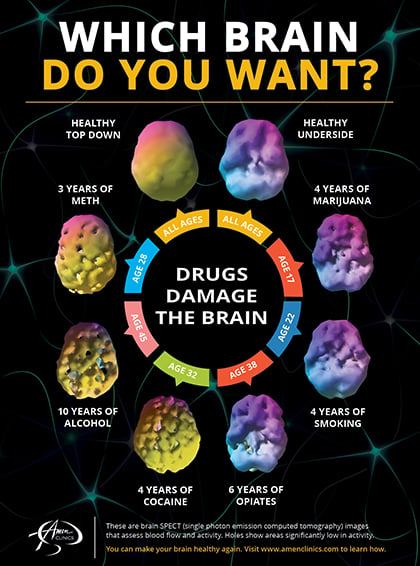
SPECT brain scans can clearly show toxic exposure from drugs and alcohol. These addictive substances negatively impact areas of the brain that play an important role in your ability to live your best life. To see the effects of drugs and alcohol on the brain, look at the following poster, which hangs in over 100,000 schools, prisons, and therapist’s offices around the world.
2. Revealing the effects of everyday drugs.
Brain imaging shows that substances like marijuana (now legal in some states), nicotine, caffeine, and even too much sugar compromise brain function.
3. Brain imaging reveals there is more than one type of addiction.
One of the most important things brain imaging shows is that addiction is not a single or simple disorder. There are 6 types of brain patterns associated with addiction, and each type requires individualized treatment. The 6 types of addiction are:
Type 1: Compulsive Addicts
Type 2: Impulsive Addicts
Type 3: Impulsive-Compulsive Addicts
Type 4: Sad of Emotional Addicts
Type 5: Anxious Addicts
Type 6: Temporal Lobe Addicts
4. SPECT brain scans reduce shame and stigma.
If you’re like most people who struggle with substance abuse, you probably think it is all your fault or that you are a bad person. Brain imaging helps erase these untrue and unhelpful thoughts. When you see that addiction is a brain disorder, it helps lift the stigma that typically comes with addiction.
5. Brain scans help break denial.
Addicts are usually the last one to admit that they have a problem. Take Chase, for example. At 18, he was drinking and using OxyContin, coke, meth, and more, but he didn’t think he had a problem. His mother eventually took him in for a brain scan, which revealed a very toxic brain. When Chase saw his brain scans, it hit him hard. Even though he didn’t think the drugs and drinking were a problem, he couldn’t deny the damage he saw in his scans. That was what he needed to finally get clean and sober.
6. Seeing your brain scan helps your family understand better.
Parents of substance abusers often feel like it’s their fault, or they blame each other for their child’s addiction. Seeing that addiction is a brain disorder eliminates these feelings and helps the entire family get focused on helping the substance abuser heal their brain.
7. Brain imaging reveals co-morbid conditions.
It is common for people with addictions to suffer from other issues, such as depression, anxiety, ADD/ADHD, bipolar disorder, or head injuries (like Rachel, who was kicked in the head by a horse). In order to heal from addiction, these other issues also need to be addressed.
8. Seeing your brain motivates you to follow a treatment plan.
For many people, like Chase, seeing how toxic their brain looks is one of the greatest motivators for treatment. When they understand that it is their brain health that is the key to having success at school, at work, and in relationships, it increases that motivation.
9. Follow your progress.
Seeing before-and-after SPECT brain scans is the best way to objectively know when an addiction treatment plan is working effectively or when it should be adjusted to promote faster healing.
10. SPECT scans give you hope.
The before-and-after scans of substance abusers show some of the greatest improvements in brain health. When you see these, it gives you hope that no matter what you are addicted to—drugs, alcohol, smoking, or even overeating—your brain can recover too.
At Amen Clinics, we use SPECT brain imaging as part of a comprehensive evaluation to help people of all ages heal from all types of addictions. We use an integrated brain-body approach to treatment that includes biological, psychological, social, and spiritual elements to identify areas of your life—or a family member’s life—that can be optimized. To learn more, call 888-288-9834 to talk to a specialist today or schedule a visit.
Do you have intrusive thoughts that keep looping in your head? Do you check the stove 20 times before you can head out the door to go to work? It could be obsessive-compulsive disorder (OCD). An estimated 2 to 4 million people struggle with OCD, a condition that is characterized by obsessive thoughts and compulsions that can be debilitating. Just look at how they were making Gail’s life spin out of control.
Gail’s OCD Obsessions and Compulsions
On the surface, it seemed like she had it all. Married to her high school sweetheart, she had a couple of kids and a good job. But every night after work, Gail spent hours obsessively cleaning her house. If she saw anything out of place, she would scream at her family and become hysterical. She also felt compelled to wash her hands over and over and over again and insisted that her husband and kids wash their hands at least 10 times a day. Gail’s OCD was ruining her life and seriously impacting her family.
What Gail’s OCD Brain Scan Showed
To get an accurate diagnosis, Gail underwent a leading-edge brain imaging technique called SPECT. Her brain scan showed marked increased activity in the Anterior Cingulate Gyrus, an area involved in shifting attention. When there’s too much activity in this area, it causes people to get stuck on thoughts and actions.
Gail’s OCD Brain Scan: Note increased activity in an area called the Anterior Cingulate Gyrus (arrow).

Healthy Active Brain Scan:

Within six weeks on a targeted treatment plan, Gail was much more relaxed, greatly reduced her ritualistic hand-washing behavior, and stopped making her kids wash their hands every time they turned around. Her husband couldn’t believe the change and said Gail was more like the woman he had married.
If you have similar symptoms as Gail, you may have OCD like Gail, and you can get unstuck too.
5 Ways to Reduce OCD Symptoms
Here are 5 simple things you can do to minimize obsessive thoughts and decrease compulsions.
1. Notice when you are stuck.
Becoming aware of looping thoughts is essential to learning how to stop them and gaining control over OCD. Whenever you notice intrusive thoughts, imagine seeing a traffic stop sign in your head and silently say to yourself, “STOP. THIS IS MY BRAIN GETTING STUCK!” For some people, the more they actively stop these thoughts, the more control they develop over them.
2. Distract yourself.
When you notice you are getting stuck, get up and do something else. If you actively distract yourself from repetitive thoughts or ritualistic compulsions, they will gradually begin to lose their control over you. Try any of the following to distract yourself:
- Take a walk.
- Sing a song that makes you happy.
- Listen to music that makes you feel positive.
- Play with a pet.
- Meditate.
- Do a household chore (unless the chore is part of a ritualistic compulsion for you).
- Focus on a single word—for example, “love” or “one”— and do not allow any other thoughts to enter your mind. If other thoughts try to creep in, imagine a broom sweeping them out of your head.
3. Focus on foods that boost serotonin.
Serotonin is a neurotransmitter that can help calm the overactive parts of the brain. Eating complex carbohydrates, such as sweet potatoes and garbanzo beans, is a healthy way to boost serotonin. Avoid consuming simple carbohydrates, such as pasta, bread, cookies, pretzels, and popcorn. Although they boost serotonin, they also contribute to increased feelings of anxiety, which is common in people with OCD.
4. Get moving.
Exercise can be very helpful in calming intrusive thoughts and can help shift your attention when compulsions arise. Exercise works by increasing serotonin in the brain. In addition, it may distract you from obsessive thoughts and ritualistic behavior and compulsions.
5. Consider supplements that boost serotonin.
Helpful supplements that raise serotonin and calm overactivity in the brain include 5-HTP.
Since 1989, Amen Clinics has helped thousands of people, including Gail, get an accurate diagnosis and overcome OCD with targeted solutions that are proven to produce higher than average success rates.
If obsessive thoughts or compulsions are controlling your life and holding you back, don’t wait to seek professional help. Schedule a visit today or call 888-288-9834 to get a comprehensive evaluation.
One of the hottest—and most controversial—topics in the field of health and wellness right now is CBD. At every mental health conference, an audience member inevitably asks, “What about CBD?” The same question pops up every day on Facebook, Instagram, and Twitter.
If you’re like most people, you may be wondering if CBD can decrease your anxiety, help your aging mother’s chronic pain, or even help your dog’s arthritis. What it can and can’t do is still being explored.
To delve into the pros and cons of CBD, Dr. Rebecca Siegel, a child, adolescent, and adult psychiatrist, recently joined Dr. Daniel Amen and Tana Amen on the Brain Warrior’s Way Podcast. In this 4-part series, you’ll find the answers to many questions about CBD, THC, and medical marijuana, such as:
- Can CBD minimize chronic pain? Alleviate anxiety? Improve your sleep issues? Decrease PTSD symptoms? Can it help with other conditions?
- What is CBD legally approved for?
- What’s the difference between CBD and THC?
- What’s the difference between CBD and medical marijuana?
- Is CBD addictive?
- Can CBD make you feel stoned?
- Is CBD bad for your brain?
- Is it helpful for people with mental health issues or does it make people worse?
- What does cannabis do to the teenage brain?
- What does the research say about CBD?
Click here to tune into the Brain Warrior’s Way podcast series with Dr. Amen, Tana Amen and special guest Dr. Rebecca Siegel from Amen Clinics New York.
Part 1: http://brainwarriorswaypodcast.com/lets-talk-about-cbd-with-dr-rebecca-siegel/
Part 2: http://brainwarriorswaypodcast.com/cbd-use-what-does-the-research-say-with-dr-rebecca-siegel/
Part 3: http://brainwarriorswaypodcast.com/medical-marijuana-whats-medically-correct-with-dr-rebecca-siegel/
Part 4: http://brainwarriorswaypodcast.com/is-cbd-good-for-your-health-with-dr-rebecca-siegel/
If you’d like more information or you’re struggling with mental health issues and are wondering about treatment options, understand that at Amen Clinics, we believe in using the least toxic, most effective treatments available. Speak with a specialist today by calling 888-288-9834 or schedule a visit.