
Does Treating Mental Health Issues Make You Lose Your Sense of Humor?
Amen Clinics attracts some very successful people—superstar musicians, athletes, actors, and CEOs—who want to get their brain scanned. Their hope is that seeing what’s happening inside their head will help them find a path to decreasing symptoms, whether they’re experiencing depression, anxiety, obsessiveness, trouble with focus and attention, PTSD, addictions, eating disorders, or other issues. They all want to feel happier, but many of them have a common concern.
If they enhance their brain health, will it take away the unique or quirky part of their personality that makes them special and that helped them achieve so much success in the first place? Will it dull their creativity? Will it make them less likely to take the necessary risks to reach greatness? Will it make them boring?
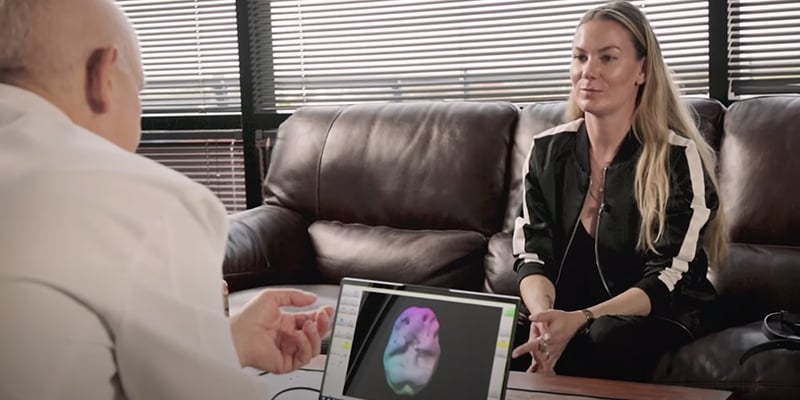
That’s what stand-up comedian and host of the Sharp Tongue and Highlarious podcasts, Jessimae Peluso, wanted to know when she came to Amen Clinics for a brain scan and evaluation as part of an influencer series called “Scan My Brain.” She asked psychiatrist and neuroscientist Daniel G. Amen, MD, the founder of Amen Clinics: “What if my broken brain is the thing that makes me funny?”
Comedian Jessimae Peluso asked psychiatrist and neuroscientist Daniel G. Amen, MD, the founder of Amen Clinics: “What if my broken brain is the thing that makes me funny?”


Mental Health Is No Laughing Matter
Peluso has spent a lifetime struggling with attention issues. In school, she was smart, but she caused problems. “I had a permanent desk in the hallway,” she admitted, “because I drove the teacher so nuts because I was more focused on entertaining and just saying whatever came to my brain.” As an adult, she wants to be able to follow through on projects without a million interruptions. “Without first Swiffering the kitchen, eating half a sandwich, going back and checking my text messages, walking out to the front to rake the yard,” she said. In her everyday life, it’s like “I’ve done 1000 things, but I never finished the thing that I set off to do.” The comedian had never really thought much about the health of her brain until her dad developed Alzheimer’s disease and died from it in 2018. That prompted her to invite Dr. Amen as a guest on her Sharpe Tongue podcast. The conversation about brain health and its relationship to psychiatric issues piqued her curiosity, and she decided to visit Amen Clinics for a brain SPECT scan. SPECT is a sophisticated brain mapping tool that measures blood flow and activity in the brain. It shows 3 things:- Areas of the brain with healthy activity
- Areas of the brain with low activity
- Areas of the brain with too much activity
What Jessimae Peluso Saw in Her Brain Scan
When Dr. Amen revealed Peluso’s brain scan to her, she asked “Why does it look like a smiley face?” She was referring to what looked like two big holes near the top of the scan. As Dr. Amen explained, the holes aren’t really holes, rather they indicate areas of low blood flow. Here’s a closer look at two areas of concern in Peluso’s brain.
- Underactivity in the prefrontal cortex: In Peluso’s scan, the two big holes she noticed were in the front part of the brain in an area called the prefrontal cortex (PFC). The PFC is involved in attention, focus, planning, organization, follow-through, impulse control, judgment, empathy, and more. When blood flow and activity are low in this brain region, it is associated with problems with these functions. It is a brain pattern that is commonly seen in people with ADD/ADHD. Considering the issues Peluso described, in addition to the results of sophisticated assessments she completed at Amen Clinics, the diagnosis of ADD/ADHD fit.
- Scalloping: On SPECT, the surface of a healthy brain looks smooth, with full, even, symmetrical blood flow and activity. That’s not what Peluso’s looked like. The comedian’s brain had a bumpy or scalloped appearance that signals overall decreased activity and blood flow.