

TL;DR
Katie Jolly struggled with mental health challenges for most of her life, often feeling ashamed and without clear answers.
Her breakthrough came after a traumatic brain injury, when, during rehabilitation for post-concussion syndrome, a doctor helped her realize her symptoms were not personal failures, but signs her brain wasn’t functioning optimally.
Through a comprehensive, brain-based evaluation at Amen Clinics and targeted lifestyle changes, she gained clarity, reduced her symptoms, and found lasting hope.
Her story shows that when you understand your brain, healing becomes possible and the path forward becomes clearer.
Medically reviewed by Larry Momaya, MD, Amen Clinics
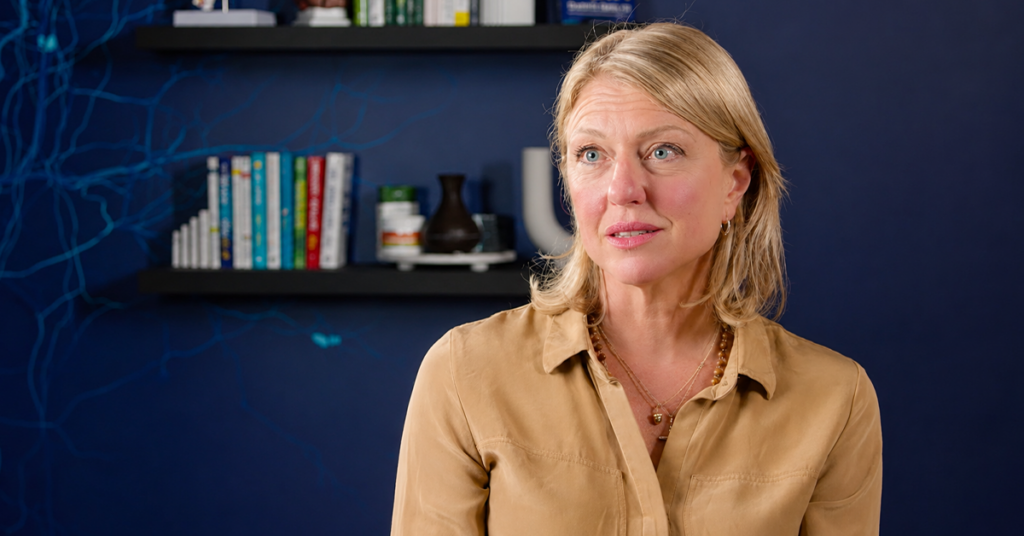
I was really healthy, but my mental health wasn’t … Then my doctor said to me, ‘Katie, it’s not you, it’s your brain,’ and all of a sudden, something clicked.
For most of her life, Katie Jolly believed she was the problem.
Early in life, she struggled with ADHD but neither she nor her parents knew what it was. As a teen she experienced depression, anxiety, and battled an out-of-control eating disorder.
In adulthood, she went through periods of intense emotional distress, including suicidal thoughts and behaviors. At times, things spiraled so far out of control that she barely recognized herself.
“I was just like a wild animal,” she says. “I would rip my hair out, punch myself in the head… my poor family went through that with me.”
Finally, after a traumatic brain injury, she sought treatment for post-concussion syndrome symptoms. While in rehabilitation, a specialist told her, “Katie, it’s not you. It’s your brain.”
Suddenly, something clicked, and Katie found herself on a path to brain health, which completely transformed her health and life. This is her story.
The mental health challenges that began in childhood for Katie, worsened in adulthood.
There were moments when her pain became overwhelming. She recalls feeling “psychotic.”
Her difficulties were not just emotional. They affected her physical health as well, contributing to serious conditions like fatty liver disease in her early twenties.
Despite her determination to get better, she found herself caught in a cycle that did not make sense. She did everything she thought she was supposed to do. She pursued health, studying naturopathy, personal training, and massage. From the outside, it looked like she was doing all the right things.
“I was really healthy,” she explains, “but my mental health wasn’t.”
She kept searching for answers, but nothing fully explained why life felt so overwhelming or why her symptoms persisted. The suffering was immense.
Unfortunately, Katie’s experience is very common.
More than half of U.S. adults with attention deficit hyperactivity disorder (ADHD), also called attention deficit disorder (ADD), are not diagnosed until adulthood, statistics show.
This is particularly true for women as ADD shows up differently for young girls. In many cases, it doesn’t involve hyperactivity symptoms, which means it often gets overlooked.
Many U.S. adults suffer alone with untreated mental illness. The Centers for Disease Control and Prevention (CDC) reports that roughly 50 percent of those with any mental illness in the U.S. have not received mental health treatment.
Stigma remains one of the biggest barriers for individuals getting the right mental health support they need. CDC data indicates that nearly 60 percent of people with mental health conditions who do not seek care, fail to seek help due to fear of judgment, discrimination, or feeling ashamed of what they are experiencing.
This stigma can keep people silent. It may lead them to hide symptoms, delay treatment, or give up on getting the support they need, which can allow problems to worsen over time.
Many people first seek help for mental health issues from their primary care physician. But research shows that in primary care settings, misdiagnosis rates can be high.
For example, one study of 840 primary care patients found that misdiagnosis rates for major depressive disorder reached 65.9 percent and 71 percent for generalized anxiety order.
Rates of misdiagnosis were even higher for panic disorder (85.8 percent), bipolar disorder (92.7 percent), and social anxiety disorder (97.8 percent).
That’s why it is also important to seek a comprehensive evaluation from a qualified mental health professional who is skilled at recognizing and diagnosing mental health conditions.
Fortunately for Katie, something transformational happened after experiencing a devastating injury. In 2020, when Katie suffered a traumatic brain injury, her entire world unraveled.
“I couldn’t work. My identity was ripped out, and I was lost,” she says.
After a year of working with a rehabilitation team, she still didn’t have clarity about how to get better. That’s when her doctor said something that completely changed the course of her life. “My doctor said to me, ‘Katie, it’s not you. It’s your brain.’”
That simple statement became her turning point. “All of a sudden, something clicked.”
For the first time, she stopped seeing herself as broken and started seeing that her brain simply needed support. Her focus shifted to improving her brain health.
At Amen Clinics, looking at brain function and its role in the development of mental health disorders helps guide more accurate diagnoses and more effective, tailored treatment plans.
Additionally, our clinicians see something powerful happen when people begin to understand that mental health struggles are not character flaws, but brain health issues. When the conversation shifts from blame to biology, the shame often fades.
With that clarity comes hope, and people are far more willing to seek help, stay engaged in treatment, and take steps toward healing. This was true for Katie.
That shift led Katie to dive into brain health. She discovered Dr. Amen’s work and began reading his book, The Brain Warrior’s Way. “As I started to read it, it tied everything together. I was just fired up.”
Her biggest change happened emotionally. “After years of feeling absolutely crazy… the shame and stigma just lifted. To be able to say, ‘It’s not you, it’s your brain,’ gives you so much hope.”
Katie had spent years in conventional systems searching for answers. What she experienced at Amen Clinics felt fundamentally different.
Instead of focusing only on symptoms, Dr. Momoya and her care team sought to understand what was actually happening in her brain and why.
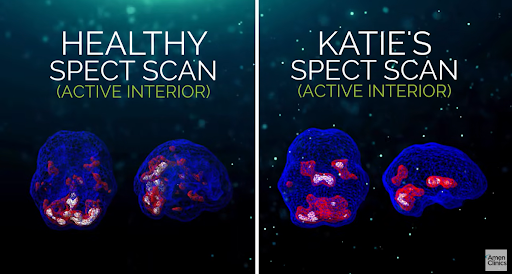
With the comprehensive evaluation, brain SPECT imaging revealed how her brain was functioning by measuring blood flow and activity. This helped identify patterns connected to her challenges with mood, behavior, and thinking.
But for Katie, the scan was just one piece.
Her evaluation also included a detailed personal history, providing insight into her life experiences, stress levels, lifestyle habits, and past trauma, including her head injury.
Neuropsychological testing helped assess her cognitive and emotional functioning. And additional labs, which were ordered as needed, helped to rule out other underlying biological issues.
Unlike many traditional psychiatric evaluations that focus only on symptoms, Amen Clinics’ method is more comprehensive. By gathering data to create a full picture of Katie, including her brain function, biology, and life history, Dr. Momoya and her care team gained a clear understanding of what was happening in her brain and body.
This whole-body approach allowed them to devise a personalized treatment plan tailored specifically to her needs.
What’s more, as Amen Clinics practices holistic psychiatry, the plan included natural ways to treat her brain injury and mental health conditions with diet, lifestyle factors, nutritional supplements, therapy, and medication, only when needed. She really responded to the integrative approach.
For Katie, it was the first time everything made sense. “It tied everything together,” she says.
Video: One Woman’s Journey Back from the Edge: How an Education in Brain Health Changed Katie’s Life
Still, taking the next step wasn’t easy. “When I came to Amen Clinics, I was really scared to see what my brain might look like,” she recalls.
But what she found, in working with Larry Momoya, MD, at Amen Clinics in Costa Mesa, California, wasn’t something to fear, but a roadmap to recovery.
Among other findings, her SPECT scan showed overactivity in the brain’s emotional and fear centers, a pattern commonly seen in anxiety and depression.
Instead of blaming herself, she began to understand that her symptoms had a biological basis. Seeing that her issues were rooted in brain function helped her believe that healing was possible. She had hope.
“What the brain scan has given me,” she says, “is that I can see exactly where I need to continue to do the work to optimize my brain function.”
For the first time, Katie’s struggles weren’t vague or mysterious. They were connected to real patterns in her brain. And having clarity changed everything.
With new insight came a clear path forward. Katie began following targeted brain-health strategies. She returned to a ketogenic diet, started taking recommended supplements, and committed to daily exercise.
The lifestyle changes didn’t just feel good. They created real results. “As I started to follow the protocols, my pain reduced. I started to feel better,” she says.
Over time, she began to notice something even more powerful.
“My brain is actually healing just from following those protocols already.”
Her experience highlights an essential truth: the brain can change, and what you do every day plays a critical role in that process.
Perhaps the most profound shift wasn’t just in her symptoms, but in how she saw herself. For years, she carried shame, believing she was flawed or broken. Now, she sees something entirely different.
“The brain can heal. It just gives you so much hope,” Katie says.
Today, Katie feels called to share that message with others. “I feel like it’s my purpose in life to help people out of the mud and join the mission to reframe mental health as brain health.”
To help her with this goal, in 2023, Katie became a certified Elite Brain Health Coach through Amen University.
In addition to coaching, she is an author, public speaker, and natural health practitioner. Katie turned her personal brain injury recovery into a mission to help others.
When she works with others who are struggling the way she once did, she offers them true understanding, something she didn’t always have.
“To be able to say to them that there’s hope, that’s a really, really massive thing,” she notes.
Katie’s story is a powerful reminder that mental health challenges are not character flaws. They are often rooted in brain health.
When you understand your brain and take a whole-body approach, you can begin to change your life.
And sometimes, the most important breakthrough starts with a simple realization: “It’s not you,” she says. “It’s your brain.”
Brain SPECT imaging can provide valuable insight into how your brain is functioning by measuring blood flow and activity patterns. While it is not a standalone diagnostic tool for conditions like anxiety, ADD/ADHD, or psychosis, it can reveal patterns associated with mood, anxiety, attention, and behavior challenges.
When used as part of a comprehensive evaluation, brain imaging helps clinicians better understand what may be driving symptoms and supports more personalized, targeted treatment.
Many mental health conditions share similar symptoms, such as anxiety, depression, or difficulty focusing.
Traditional evaluations often rely heavily on symptom checklists and self-reported experiences, which can make it difficult to distinguish between different conditions or identify co-occurring issues.
Without looking at underlying brain function, important differences can be missed, leading to higher rates of misdiagnosis and less effective treatment.
A brain-based focus looks beyond symptoms to understand how the brain is actually working. At Amen Clinics, this includes brain SPECT imaging, a detailed personal history, and cognitive assessments to create a more complete picture of each individual.
This whole-body approach, grounded in holistic psychiatry, allows clinicians to identify root causes and develop personalized treatment plans that may include lifestyle strategies, nutrition, supplements, therapy, and medication when needed.
When people understand that their struggles are related to brain health, not personal failure, it often reduces shame and makes it easier to seek and stay engaged in care.
Traumatic brain injury, ADHD, psychosis, and other mental health conditions can’t wait. At Amen Clinics, we practice precision medicine—using brain SPECT imaging and comprehensive evaluations to understand what’s really happening in your brain, not just your symptoms.
Our whole-body approach to holistic psychiatry combines cutting-edge neuroscience with natural ways to treat mental health conditions, including targeted nutrition, supplements, lifestyle strategies, therapy, and medications (when necessary). Every treatment plan is personalized to address the root causes of your struggles and support the health of your brain, body, and mind.
Don’t settle for guesswork. You deserve answers—and a plan built specifically for you. Speak with a Brain Health Advisor today at 888-288-9834 or visit our contact page to get started.
About the Reviewer
Dr. Larry Momaya is a board-certified adult psychiatrist and Fellow of the American Psychiatric Association. A UC Irvine College of Medicine graduate, he completed his psychiatry residency at UC Irvine in 2004 and has helped thousands of patients at Amen Clinics since then. He works with mood and anxiety disorders, ADHD, emotional overeating, addictions, relationship issues, and self-esteem concerns. Dr. Momaya uses an integrative approach that may include psychotherapy, hypnosis, visualization, spirituality, meditation, breathing techniques, and thought investigation to support mental wellness and personal empowerment.
References
Centers for Disease Control and Prevention website
Facts About ADHD in Adults
https://www.cdc.gov/adhd/php/adults/index.html
Accessed April 28, 2026
National Institute of Mental Health website
Mental Health Information
https://www.nimh.nih.gov/health/statistics/mental-illness
Accessed April 28, 2026
Centers for Disease Control and Prevention website
Mental Health Stigma
https://www.cdc.gov/mental-health/stigma/index.html
Accessed April 28, 2026
Vermani M, Marcus M, Katzman MA. Rates of detection of mood and anxiety disorders in primary care: a descriptive, cross-sectional study. Prim Care Companion CNS Disord. 2011;13(2):PCC.10m01013.