

Irlen Syndrome: Heather’s Transformation
Imagine sitting in a room at home with goggles and headphones on. Strobe lights flicker through the goggles and pulses come through the headphones, both designed to stimulate your mind. Our minds think in states of brain- wave frequency, and changes in frequencies are based on brain activity. When we stimulate the brain audiovisually with light and sound pulses, it begins to mimic or follow the same frequencies.
Irlen Lenses: Brain-Calming Glasses
When a patient who had severe, debilitating migraine headaches told us that being diagnosed with and treated for Irlen syndrome completely cured her headaches, we wanted to help more like her. Helen Irlen, PhD, is a school psychologist. Back in the early 1980s she was working under a federal research grant with college-educated adults who struggled with learning and reading difficulties. At that time, she discovered that colored, filtered lenses could reduce stress on the brain and allow it to function better. Irlen Syndrome is a visual processing problem, where certain colors of the light spectrum tend to irritate the brain. It runs in families and is common after traumatic brain injuries. Anyone experiencing symptoms of anxiety, irritability, depression, or decreased concentration should be screened for Irlen syndrome. Common symptoms include: • Light sensitivity; being bothered by glare, sunlight, headlights, or streetlights • Strain or fatigue with computer use • Fatigue, headaches, mood changes, restlessness, or an inability to stay focused when in a room with bright or fluorescent lights • Trouble reading words that are on white, glossy paper • Words or letters shifting, shaking, blurring, moving, running together, disappearing, or becoming difficult to perceive while reading • Feeling tense, tired, or sleepy when reading, or even getting headaches when reading • Problems judging distance and difficulty with such things as escalators, stairs, ball sports, driving, or coordination • Migraine headachesMeet Heather
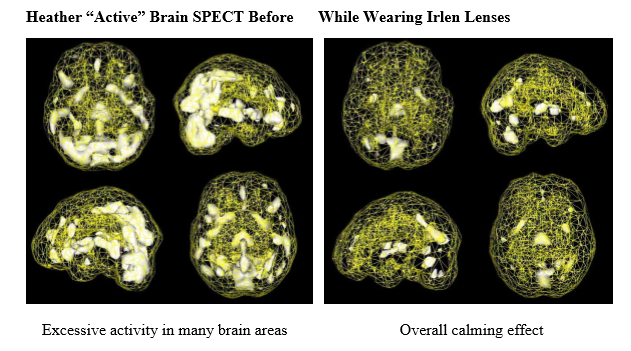
Heather, 42, had been in 10 car accidents when she came to see us for symptoms of ADHD, anxiety, and depression. During her history she told one of our physicians that she had trouble reading and fluorescent lights gave her headaches. Suspecting Irlen Syndrome, he sent her for an evaluation. When we saw Heather two weeks later, she was beaming. With the Irlen lenses, her focus was better, her anxiety was reduced, and her mood had improved. Her prior brain scan had been remarkably overactive, but the Irlen lenses significantly calmed her brain.