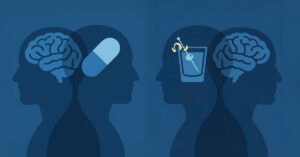

How Addictions Get Stuck in Your Brain
Why are some people who overdo it with alcohol, food, sex, or other things, able to remember the consequences of their actions, learn from their mistakes, and avoid repeating the behavior? And why do others minimize the consequences, maximize the pleasure they got from the activity, and continue to engage in the same destructive behavior?
The answer lies in the way your brain is wired.
Why Am I A Slave to These Cravings? Understanding the Brain’s Reward System
Whether you experience consequences and quit the bad behavior or keep repeating it depends in large part on the biological makeup of your brain and your brain’s reward system. What is the brain’s reward system? It is an intricate network of brain systems and neurotransmitters that are critical to human survival. It drives us to seek out the things we need to stay alive and carry on the human race. Many other things that are not necessarily crucial to our survival also activate the reward system:- Listening to music
- Taking a warm bath
- Looking at a beautiful painting
- Cocaine
- Methamphetamines
- Heroin
- Alcohol
- Caramel fudge brownies
- Playing video games
- Excessive texting and gambling
BRAIN CHEMICALS INVOLVED WITH CRAVINGS AND SELF-CONTROL
Dopamine—motivation, saliency, drive, stimulant Serotonin—happy, anti-worry, calming GABA—inhibitory, calms, relaxes Endorphins—pleasure and pain-killing properties- Dopamine is a feel-good chemical. Whenever we do something enjoyable, it’s like pressing a button in the brain to release a little bit of dopamine to make us feel pleasure. Cocaine, methamphetamines, alcohol, and nicotine all cause dopamine surges that make these substances highly desirable—sometimes even more desirable than the things we need to survive like food, water, and sex. The amount of dopamine released when drugs are taken can be two to ten times more than what your brain produces for natural rewards.
- Serotonin is thought of as the happy, anti-worry, flexibility chemical. Many of the current antidepressants work on this neurotransmitter. When serotonin levels are low, people tend to be worried, rigid, inflexible, oppositional and argumentative, and suffer from anxiety, depression, obsessive thinking, or compulsive behaviors. Simple carbohydrates increase l-tryptophan in the brain, which is why some people can get hooked on cookies, bread, potatoes, and sugar.
- GABA, or gamma-aminobutyric acid, is an inhibitory neurotransmitter that calms or helps to relax the brain. If you have suffered an emotional trauma or you are under a lot of stress, GABA may be depleted and your emotional or limbic brain may become excessively active, making you feel anxious, uptight, or sad. This makes you eat or drink in an attempt to calm your limbic brain.
- Endorphins are the brain’s own natural pleasure and pain-killing chemicals. They are the body’s own natural morphine or heroin-like substances. These substances are heavily involved in addiction and the loss of control.